
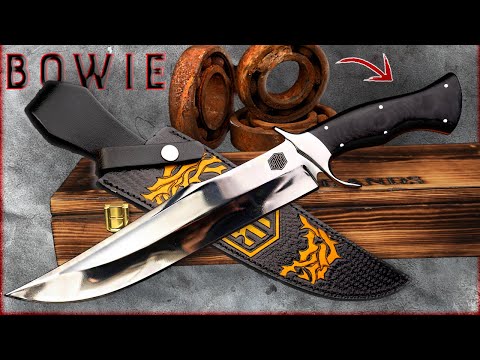
Random Hands • Buy the "Sunshine Bowie Knife" here:https://randomhands.net/product/sunshine-bowie-knife/ Act fast as it comes first, served first. Only a LIMITED stock available. SUNSHINE BOWIE KNIFE Material of Knife = Stainless steel 440C Knife Hardness = 58 HRC Knife Weight = 550grams Sheath Material = Cow Leather Handle Material = G10 Glass resin Class = Fixed Blade full tang knife Shape = Clip point Bowie Total Length = 16 inches History and Experiments : A question that could be raised is why it took me around two years to launch this product? Back in 2023, when I started working on the "Sunshine Bowie knife," I selected a piece of high carbon steel known for its strength, hardness, and toughness, though it had low tensile strength. I was excited to produce these knives in bulk using the same high carbon steel. However, when I conducted a corrosion resistance test, the carbon steel knife failed and developed a significant amount of rust on the surface. This was very disappointing, so I began searching for the perfect steel to meet our requirements. I visited my local market and examined various types of steel. After extensive research, I chose "Sandvik steel 12C27," which offers good edge retention and a significant level of rust resistance. I purchased this steel from the local market and started working on the project to produce Sunshine Bowie knives in quantity. It took me several months to get them ready, and I was pleased with this type of steel. However, I noticed that there was still a gap between my requirements and the performance of this steel. When I placed my 12C27 knife in the sheath for a few days, I observed some oxidation on the surface, which was very disappointing for me. Why I chosen the 12c27? o. It had similar strength as in High Carbon steels. o. It could hold edge. o. It had good amount of carbon to make sure the hardness of knife. o. Major reason it has a great rust resistivity. o. It had a good toughness and resistivity against cracks. But Why I Discarded the whole lot of knives made of 12c27? o. It was still oxidising by moisture. o. The max hardness was not meeting my criteria. o. Low hardness compared to Carbon steel. The main reason I moved away from this steel was that it couldn’t withstand moisture, and I wanted a knife that could endure harsh environments while providing super hardness, good strength, and excellent rust resistance, all while maintaining a better edge like high carbon steel. I ended up wasting a lot of money on this discarded Bowie knife lot, but I didn’t lose hope. I continued to search and study different steels. The final steel that met my requirements was called "440C stainless steel." However, there was a problem: this steel wasn’t easily available, and I couldn’t find it locally. I collaborated with people who could source this steel for me and I trusted them, but I faced another significant loss of wasting whole lot of knives, because the steel they provided us was actually locally casted steel. This was really upsetting, so I decided to get the certified 440C steel. In the meantime, I kept studying the anatomy of this steel. Fortunately, I found the certified 440C steel. I purchased a sample first and conducted all my experiments on it, and it passed, meeting all my expectations. Why I chosen the 440C steel? o. It has good strength. o. Give a great edge retention. o. Super rust resistive in any environment. o. Gives a hardness similar to High carbon steel (58~60HRC) o. Has high carbon content o. Has a great retention against ACIDS. However, there was still one compromise I had to make. In my search for rust resistance, I had to sacrifice some toughness in this steel. It’s a low-toughness material, meaning it can get cracks. If you temper it to improve toughness, it loses the required hardness. So, I found a middle ground where it maintained a hardness of about 57-58 HRC while also providing good toughness and edge retention. With that, I proceeded with production using 440C steel, and I created a lot that turned out beautifully and was nearly perfect. This is the whole story of the Sunshine Bowie knife why I took me years to make. The leather sheath has a similar story but I am running out of words in description box. Visit us on Our Snapchat: https://story.snapchat.com/p/c96d1d2e-899d-4da4-a20a-1901868a2182/760041188628480?invite_id=ID3lWcuN&locale=en-GB&share_id=1bVvei8gzVo×tamp=37820&sid=e9cf83bd1c8c4f5b9738e822d8619aa0&sender_web_id=cc129e1f-4b28-479b-a298-db428cb80d0a&device_type=desktop&is_copy_url=true Our Instagram: https://www.instagram.com/random.hands/ Youtube Channel = www.youtube.com/randomhands Our Facebook = https://www.facebook.com/randomhands Youtube Subscription: https://www.youtube.com/channel/UCrI3dm4qgAEV67Jc6797WIA?sub_confirmation=1 Best wishes Random Hands
Content Summary
This report is generated from research on the following videos, based on the requirements set in Video Deep Research.
Analyze selected videos,
My goal is 📑 Discover Content Intelligence
My role is 🎓 Teacher/Educator/Coach
I need: 🏆 Teaching methodology effectiveness analysis & optimization, 📝 Key concept summarization and concept mapping, ⛰️ Learning pathway recommendations


https:...IYzv
Summary
1. Optimizing Delivery Through Iterative Material Analysis
2. Precision Feedback Mechanisms for Quality Control
3. Scalable Pathways and Versatile Subject Mastery
Knowledge Snap
Method 1: Iterative Material Analysis
🎬 Related Clip
(3)
Video Title
00:24 - 02:24
The maker selects 440C stainless steel as the primary material for the selling product.
00:39 - 02:39
High carbon steel is noted for its tendency to rust very easily.
16:42 - 18:42
The maker opts for 440C steel to handle the demands of tough environments.
Method 2: Multi-Stage Assessment Strategies
🎬 Related Clip
(3)
Video Title
30:59 - 32:59
A sharpness test is initiated to see how well the blade cuts.
39:20 - 41:20
The maker moves the handle testing from a hammer to a hydraulic press.
42:08 - 44:08
The knife is tested for durability against the weight of a bulldozer.
Method 3: Deep Contextual Specialization
🎬 Related Clip
(3)
Video Title
05:46 - 07:46
Forging is followed by thermal cycles to stabilize the steel.
13:25 - 15:25
The maker states that overall quality depends heavily on the heat treatment process.
13:45 - 15:45
Using wooden planks for cooling helps prevent the steel from warping.
Method 4: Personalized Feedback Loops
🎬 Related Clip
(3)
Video Title
10:02 - 12:02
Carefully filing imperfections is described as the most effective identification method.
27:23 - 29:23
Roughness is smoothed out using sandpapers ranging from low to high grits.
27:29 - 29:29
More effort in hand sanding leads to smoother results and a better outcome.
Method 5: Holistic Learner Support Systems
🎬 Related Clip
(3)
Video Title
46:27 - 48:27
A handmade box is provided as a free gift with the knife purchase.
46:52 - 48:52
The leather sheath features a belt loop for users to carry it on adventures.
49:29 - 50:46
Instructional books and authentication cards are included in the main packaging.
Method 6: Adaptive Instructional Design
🎬 Related Clip
(3)
Video Title
33:55 - 35:55
The maker notes that normally a collection of knives is needed for different situations.
34:04 - 36:04
The new Bowie knife is introduced as a versatile, sharp, and rust-resistant option.
34:17 - 36:17
The knife is suitable for tasks ranging from bone cutting to woodworking in aquatic environments.
Methodology Optimization and Material Analysis Cycle
UCrI3dm4qgAEV67Jc6797WIA
🛠️
Initial Material Demonstration
00:24 - 02:24
The process begins with selecting a sample material to demonstrate the initial forging and construction phases.
🔍
Iterative Flaw Identification
10:02 - 12:02
A meticulous visual inspection technique is used to find and mark imperfections for manual correction.
📚
Applied Structural Research
13:30 - 15:30
Deep study of material properties leads to breakthroughs in critical processes like heat treatment for durability.
⚔️
Primary Performance Validation
16:35 - 18:35
Direct testing against hard materials confirms the effectiveness of the refined treatment and steel selection.
🏗️
Component Durability Selection
21:40 - 23:40
Secondary materials are analyzed and chosen based on their ability to withstand heavy-duty environments and stress.
📍
Point Stress Evaluation
35:36 - 37:36
Targeted testing on vulnerable areas ensures the structural integrity of the design under extreme pressure.
🧪
Comparative Environmental Testing
36:52 - 38:52
The product is benchmarked against standard alternatives to prove its superior resistance to environmental degradation.
🏆
Final Culmination Analysis
49:58 - 50:46
Reflecting on the long-term experimental process reveals the dedication required to achieve high-quality output.
Learning Pathway for Content Intelligence and Strategic Refinement
| Stage | Videos |
|---|---|
1. Comparative Material Analysis | wie Knife" here:https://randomhands.net/product/sunshine-bowie-knife/ Act fast as it comes first, served first. Only a LIMITED stock available. SUNSHINE BOWIE KNIFE Material of Knife = Stainless steel 440C Knife Hardness = 58 HRC Knife Weight = 550grams Sheath Material = Cow Leather Handle Material = G10 Glass resin Class = Fixed Blade full tang knife Shape = Clip point Bowie Total Length = 16 inches History and Experiments : A question that could be raised is why it took me around two years to launch this product? Back in 2023, when I started working on the "Sunshine Bowie knife," I selected a piece of high carbon steel known for its strength, hardness, and toughness, though it had low tensile strength. I was excited to produce these knives in bulk using the same high carbon steel. However, when I conducted a corrosion resistance test, the carbon steel knife failed and developed a significant amount of rust on the surface. This was very disappointing, so I began searching for the perfect steel to meet our requirements. I visited my local market and examined various types of steel. After extensive research, I chose "Sandvik steel 12C27," which offers good edge retention and a significant level of rust resistance. I purchased this steel from the local market and started working on the project to produce Sunshine Bowie knives in quantity. It took me several months to get them ready, and I was pleased with this type of steel. However, I noticed that there was still a gap between my requirements and the performance of this steel. When I placed my 12C27 knife in the sheath for a few days, I observed some oxidation on the surface, which was very disappointing for me. Why I chosen the 12c27? o. It had similar strength as in High Carbon steels. o. It could hold edge. o. It had good amount of carbon to make sure the hardness of knife. o. Major reason it has a great rust resistivity. o. It had a good toughness and resistivity against cracks. But Why I Discarded the whole lot of knives made of 12c27? o. It was still oxidising by moisture. o. The max hardness was not meeting my criteria. o. Low hardness compared to Carbon steel. The main reason I moved away from this steel was that it couldn’t withstand moisture, and I wanted a knife that could endure harsh environments while providing super hardness, good strength, and excellent rust resistance, all while maintaining a better edge like high carbon steel. I ended up wasting a lot of money on this discarded Bowie knife lot, but I didn’t lose hope. I continued to search and study different steels. The final steel that met my requirements was called "440C stainless steel." However, there was a problem: this steel wasn’t easily available, and I couldn’t find it locally. I collaborated with people who could source this steel for me and I trusted them, but I faced another significant loss of wasting whole lot of knives, because the steel they provided us was actually locally casted steel. This was really upsetting, so I decided to get the certified 440C steel. In the meantime, I kept studying the anatomy of this steel. Fortunately, I found the certified 440C steel. I purchased a sample first and conducted all my experiments on it, and it passed, meeting all my expectations. Why I chosen the 440C steel? o. It has good strength. o. Give a great edge retention. o. Super rust resistive in any environment. o. Gives a hardness similar to High carbon steel (58~60HRC) o. Has high carbon content o. Has a great retention against ACIDS. However, there was still one compromise I had to make. In my search for rust resistance, I had to sacrifice some toughness in this steel. It’s a low-toughness material, meaning it can get cracks. If you temper it to improve toughness, it loses the required hardness. So, I found a middle ground where it maintained a hardness of about 57-58 HRC while also providing good toughness and edge retention. With that, I proceeded with production using 440C steel, and I created a lot that turned out beautifully and was nearly perfect. This is the whole story of the Sunshine Bowie knife why I took me years to make. The leather sheath has a similar story but I am running out of words in description box. Visit us on Our Snapchat: https://story.snapchat.com/p/c96d1d2e-899d-4da4-a20a-1901868a2182/760041188628480?invite_id=ID3lWcuN&locale=en-GB&share_id=1bVvei8gzVo×tamp=37820&sid=e9cf83bd1c8c4f5b9738e822d8619aa0&sender_web_id=cc129e1f-4b28-479b-a298-db428cb80d0a&device_type=desktop&is_copy_url=true Our Instagram: https://www.instagram.com/random.hands/ Youtube Channel = www.youtube.com/randomhands Our Facebook = https://www.facebook.com/randomhands Youtube Subscription: https://www.youtube.com/channel/UCrI3dm4qgAEV67Jc6797WIA?sub_confirmation=1 Best wishes Random Hands |
2. Visual Feedback Loops for Refinement | wie Knife" here:https://randomhands.net/product/sunshine-bowie-knife/ Act fast as it comes first, served first. Only a LIMITED stock available. SUNSHINE BOWIE KNIFE Material of Knife = Stainless steel 440C Knife Hardness = 58 HRC Knife Weight = 550grams Sheath Material = Cow Leather Handle Material = G10 Glass resin Class = Fixed Blade full tang knife Shape = Clip point Bowie Total Length = 16 inches History and Experiments : A question that could be raised is why it took me around two years to launch this product? Back in 2023, when I started working on the "Sunshine Bowie knife," I selected a piece of high carbon steel known for its strength, hardness, and toughness, though it had low tensile strength. I was excited to produce these knives in bulk using the same high carbon steel. However, when I conducted a corrosion resistance test, the carbon steel knife failed and developed a significant amount of rust on the surface. This was very disappointing, so I began searching for the perfect steel to meet our requirements. I visited my local market and examined various types of steel. After extensive research, I chose "Sandvik steel 12C27," which offers good edge retention and a significant level of rust resistance. I purchased this steel from the local market and started working on the project to produce Sunshine Bowie knives in quantity. It took me several months to get them ready, and I was pleased with this type of steel. However, I noticed that there was still a gap between my requirements and the performance of this steel. When I placed my 12C27 knife in the sheath for a few days, I observed some oxidation on the surface, which was very disappointing for me. Why I chosen the 12c27? o. It had similar strength as in High Carbon steels. o. It could hold edge. o. It had good amount of carbon to make sure the hardness of knife. o. Major reason it has a great rust resistivity. o. It had a good toughness and resistivity against cracks. But Why I Discarded the whole lot of knives made of 12c27? o. It was still oxidising by moisture. o. The max hardness was not meeting my criteria. o. Low hardness compared to Carbon steel. The main reason I moved away from this steel was that it couldn’t withstand moisture, and I wanted a knife that could endure harsh environments while providing super hardness, good strength, and excellent rust resistance, all while maintaining a better edge like high carbon steel. I ended up wasting a lot of money on this discarded Bowie knife lot, but I didn’t lose hope. I continued to search and study different steels. The final steel that met my requirements was called "440C stainless steel." However, there was a problem: this steel wasn’t easily available, and I couldn’t find it locally. I collaborated with people who could source this steel for me and I trusted them, but I faced another significant loss of wasting whole lot of knives, because the steel they provided us was actually locally casted steel. This was really upsetting, so I decided to get the certified 440C steel. In the meantime, I kept studying the anatomy of this steel. Fortunately, I found the certified 440C steel. I purchased a sample first and conducted all my experiments on it, and it passed, meeting all my expectations. Why I chosen the 440C steel? o. It has good strength. o. Give a great edge retention. o. Super rust resistive in any environment. o. Gives a hardness similar to High carbon steel (58~60HRC) o. Has high carbon content o. Has a great retention against ACIDS. However, there was still one compromise I had to make. In my search for rust resistance, I had to sacrifice some toughness in this steel. It’s a low-toughness material, meaning it can get cracks. If you temper it to improve toughness, it loses the required hardness. So, I found a middle ground where it maintained a hardness of about 57-58 HRC while also providing good toughness and edge retention. With that, I proceeded with production using 440C steel, and I created a lot that turned out beautifully and was nearly perfect. This is the whole story of the Sunshine Bowie knife why I took me years to make. The leather sheath has a similar story but I am running out of words in description box. Visit us on Our Snapchat: https://story.snapchat.com/p/c96d1d2e-899d-4da4-a20a-1901868a2182/760041188628480?invite_id=ID3lWcuN&locale=en-GB&share_id=1bVvei8gzVo×tamp=37820&sid=e9cf83bd1c8c4f5b9738e822d8619aa0&sender_web_id=cc129e1f-4b28-479b-a298-db428cb80d0a&device_type=desktop&is_copy_url=true Our Instagram: https://www.instagram.com/random.hands/ Youtube Channel = www.youtube.com/randomhands Our Facebook = https://www.facebook.com/randomhands Youtube Subscription: https://www.youtube.com/channel/UCrI3dm4qgAEV67Jc6797WIA?sub_confirmation=1 Best wishes Random Hands |
3. Theoretical Deep-Dive for Optimization | wie Knife" here:https://randomhands.net/product/sunshine-bowie-knife/ Act fast as it comes first, served first. Only a LIMITED stock available. SUNSHINE BOWIE KNIFE Material of Knife = Stainless steel 440C Knife Hardness = 58 HRC Knife Weight = 550grams Sheath Material = Cow Leather Handle Material = G10 Glass resin Class = Fixed Blade full tang knife Shape = Clip point Bowie Total Length = 16 inches History and Experiments : A question that could be raised is why it took me around two years to launch this product? Back in 2023, when I started working on the "Sunshine Bowie knife," I selected a piece of high carbon steel known for its strength, hardness, and toughness, though it had low tensile strength. I was excited to produce these knives in bulk using the same high carbon steel. However, when I conducted a corrosion resistance test, the carbon steel knife failed and developed a significant amount of rust on the surface. This was very disappointing, so I began searching for the perfect steel to meet our requirements. I visited my local market and examined various types of steel. After extensive research, I chose "Sandvik steel 12C27," which offers good edge retention and a significant level of rust resistance. I purchased this steel from the local market and started working on the project to produce Sunshine Bowie knives in quantity. It took me several months to get them ready, and I was pleased with this type of steel. However, I noticed that there was still a gap between my requirements and the performance of this steel. When I placed my 12C27 knife in the sheath for a few days, I observed some oxidation on the surface, which was very disappointing for me. Why I chosen the 12c27? o. It had similar strength as in High Carbon steels. o. It could hold edge. o. It had good amount of carbon to make sure the hardness of knife. o. Major reason it has a great rust resistivity. o. It had a good toughness and resistivity against cracks. But Why I Discarded the whole lot of knives made of 12c27? o. It was still oxidising by moisture. o. The max hardness was not meeting my criteria. o. Low hardness compared to Carbon steel. The main reason I moved away from this steel was that it couldn’t withstand moisture, and I wanted a knife that could endure harsh environments while providing super hardness, good strength, and excellent rust resistance, all while maintaining a better edge like high carbon steel. I ended up wasting a lot of money on this discarded Bowie knife lot, but I didn’t lose hope. I continued to search and study different steels. The final steel that met my requirements was called "440C stainless steel." However, there was a problem: this steel wasn’t easily available, and I couldn’t find it locally. I collaborated with people who could source this steel for me and I trusted them, but I faced another significant loss of wasting whole lot of knives, because the steel they provided us was actually locally casted steel. This was really upsetting, so I decided to get the certified 440C steel. In the meantime, I kept studying the anatomy of this steel. Fortunately, I found the certified 440C steel. I purchased a sample first and conducted all my experiments on it, and it passed, meeting all my expectations. Why I chosen the 440C steel? o. It has good strength. o. Give a great edge retention. o. Super rust resistive in any environment. o. Gives a hardness similar to High carbon steel (58~60HRC) o. Has high carbon content o. Has a great retention against ACIDS. However, there was still one compromise I had to make. In my search for rust resistance, I had to sacrifice some toughness in this steel. It’s a low-toughness material, meaning it can get cracks. If you temper it to improve toughness, it loses the required hardness. So, I found a middle ground where it maintained a hardness of about 57-58 HRC while also providing good toughness and edge retention. With that, I proceeded with production using 440C steel, and I created a lot that turned out beautifully and was nearly perfect. This is the whole story of the Sunshine Bowie knife why I took me years to make. The leather sheath has a similar story but I am running out of words in description box. Visit us on Our Snapchat: https://story.snapchat.com/p/c96d1d2e-899d-4da4-a20a-1901868a2182/760041188628480?invite_id=ID3lWcuN&locale=en-GB&share_id=1bVvei8gzVo×tamp=37820&sid=e9cf83bd1c8c4f5b9738e822d8619aa0&sender_web_id=cc129e1f-4b28-479b-a298-db428cb80d0a&device_type=desktop&is_copy_url=true Our Instagram: https://www.instagram.com/random.hands/ Youtube Channel = www.youtube.com/randomhands Our Facebook = https://www.facebook.com/randomhands Youtube Subscription: https://www.youtube.com/channel/UCrI3dm4qgAEV67Jc6797WIA?sub_confirmation=1 Best wishes Random Hands |
4. Versatility and Environmental Application | wie Knife" here:https://randomhands.net/product/sunshine-bowie-knife/ Act fast as it comes first, served first. Only a LIMITED stock available. SUNSHINE BOWIE KNIFE Material of Knife = Stainless steel 440C Knife Hardness = 58 HRC Knife Weight = 550grams Sheath Material = Cow Leather Handle Material = G10 Glass resin Class = Fixed Blade full tang knife Shape = Clip point Bowie Total Length = 16 inches History and Experiments : A question that could be raised is why it took me around two years to launch this product? Back in 2023, when I started working on the "Sunshine Bowie knife," I selected a piece of high carbon steel known for its strength, hardness, and toughness, though it had low tensile strength. I was excited to produce these knives in bulk using the same high carbon steel. However, when I conducted a corrosion resistance test, the carbon steel knife failed and developed a significant amount of rust on the surface. This was very disappointing, so I began searching for the perfect steel to meet our requirements. I visited my local market and examined various types of steel. After extensive research, I chose "Sandvik steel 12C27," which offers good edge retention and a significant level of rust resistance. I purchased this steel from the local market and started working on the project to produce Sunshine Bowie knives in quantity. It took me several months to get them ready, and I was pleased with this type of steel. However, I noticed that there was still a gap between my requirements and the performance of this steel. When I placed my 12C27 knife in the sheath for a few days, I observed some oxidation on the surface, which was very disappointing for me. Why I chosen the 12c27? o. It had similar strength as in High Carbon steels. o. It could hold edge. o. It had good amount of carbon to make sure the hardness of knife. o. Major reason it has a great rust resistivity. o. It had a good toughness and resistivity against cracks. But Why I Discarded the whole lot of knives made of 12c27? o. It was still oxidising by moisture. o. The max hardness was not meeting my criteria. o. Low hardness compared to Carbon steel. The main reason I moved away from this steel was that it couldn’t withstand moisture, and I wanted a knife that could endure harsh environments while providing super hardness, good strength, and excellent rust resistance, all while maintaining a better edge like high carbon steel. I ended up wasting a lot of money on this discarded Bowie knife lot, but I didn’t lose hope. I continued to search and study different steels. The final steel that met my requirements was called "440C stainless steel." However, there was a problem: this steel wasn’t easily available, and I couldn’t find it locally. I collaborated with people who could source this steel for me and I trusted them, but I faced another significant loss of wasting whole lot of knives, because the steel they provided us was actually locally casted steel. This was really upsetting, so I decided to get the certified 440C steel. In the meantime, I kept studying the anatomy of this steel. Fortunately, I found the certified 440C steel. I purchased a sample first and conducted all my experiments on it, and it passed, meeting all my expectations. Why I chosen the 440C steel? o. It has good strength. o. Give a great edge retention. o. Super rust resistive in any environment. o. Gives a hardness similar to High carbon steel (58~60HRC) o. Has high carbon content o. Has a great retention against ACIDS. However, there was still one compromise I had to make. In my search for rust resistance, I had to sacrifice some toughness in this steel. It’s a low-toughness material, meaning it can get cracks. If you temper it to improve toughness, it loses the required hardness. So, I found a middle ground where it maintained a hardness of about 57-58 HRC while also providing good toughness and edge retention. With that, I proceeded with production using 440C steel, and I created a lot that turned out beautifully and was nearly perfect. This is the whole story of the Sunshine Bowie knife why I took me years to make. The leather sheath has a similar story but I am running out of words in description box. Visit us on Our Snapchat: https://story.snapchat.com/p/c96d1d2e-899d-4da4-a20a-1901868a2182/760041188628480?invite_id=ID3lWcuN&locale=en-GB&share_id=1bVvei8gzVo×tamp=37820&sid=e9cf83bd1c8c4f5b9738e822d8619aa0&sender_web_id=cc129e1f-4b28-479b-a298-db428cb80d0a&device_type=desktop&is_copy_url=true Our Instagram: https://www.instagram.com/random.hands/ Youtube Channel = www.youtube.com/randomhands Our Facebook = https://www.facebook.com/randomhands Youtube Subscription: https://www.youtube.com/channel/UCrI3dm4qgAEV67Jc6797WIA?sub_confirmation=1 Best wishes Random Hands |
5. Extreme Durability Performance Review | wie Knife" here:https://randomhands.net/product/sunshine-bowie-knife/ Act fast as it comes first, served first. Only a LIMITED stock available. SUNSHINE BOWIE KNIFE Material of Knife = Stainless steel 440C Knife Hardness = 58 HRC Knife Weight = 550grams Sheath Material = Cow Leather Handle Material = G10 Glass resin Class = Fixed Blade full tang knife Shape = Clip point Bowie Total Length = 16 inches History and Experiments : A question that could be raised is why it took me around two years to launch this product? Back in 2023, when I started working on the "Sunshine Bowie knife," I selected a piece of high carbon steel known for its strength, hardness, and toughness, though it had low tensile strength. I was excited to produce these knives in bulk using the same high carbon steel. However, when I conducted a corrosion resistance test, the carbon steel knife failed and developed a significant amount of rust on the surface. This was very disappointing, so I began searching for the perfect steel to meet our requirements. I visited my local market and examined various types of steel. After extensive research, I chose "Sandvik steel 12C27," which offers good edge retention and a significant level of rust resistance. I purchased this steel from the local market and started working on the project to produce Sunshine Bowie knives in quantity. It took me several months to get them ready, and I was pleased with this type of steel. However, I noticed that there was still a gap between my requirements and the performance of this steel. When I placed my 12C27 knife in the sheath for a few days, I observed some oxidation on the surface, which was very disappointing for me. Why I chosen the 12c27? o. It had similar strength as in High Carbon steels. o. It could hold edge. o. It had good amount of carbon to make sure the hardness of knife. o. Major reason it has a great rust resistivity. o. It had a good toughness and resistivity against cracks. But Why I Discarded the whole lot of knives made of 12c27? o. It was still oxidising by moisture. o. The max hardness was not meeting my criteria. o. Low hardness compared to Carbon steel. The main reason I moved away from this steel was that it couldn’t withstand moisture, and I wanted a knife that could endure harsh environments while providing super hardness, good strength, and excellent rust resistance, all while maintaining a better edge like high carbon steel. I ended up wasting a lot of money on this discarded Bowie knife lot, but I didn’t lose hope. I continued to search and study different steels. The final steel that met my requirements was called "440C stainless steel." However, there was a problem: this steel wasn’t easily available, and I couldn’t find it locally. I collaborated with people who could source this steel for me and I trusted them, but I faced another significant loss of wasting whole lot of knives, because the steel they provided us was actually locally casted steel. This was really upsetting, so I decided to get the certified 440C steel. In the meantime, I kept studying the anatomy of this steel. Fortunately, I found the certified 440C steel. I purchased a sample first and conducted all my experiments on it, and it passed, meeting all my expectations. Why I chosen the 440C steel? o. It has good strength. o. Give a great edge retention. o. Super rust resistive in any environment. o. Gives a hardness similar to High carbon steel (58~60HRC) o. Has high carbon content o. Has a great retention against ACIDS. However, there was still one compromise I had to make. In my search for rust resistance, I had to sacrifice some toughness in this steel. It’s a low-toughness material, meaning it can get cracks. If you temper it to improve toughness, it loses the required hardness. So, I found a middle ground where it maintained a hardness of about 57-58 HRC while also providing good toughness and edge retention. With that, I proceeded with production using 440C steel, and I created a lot that turned out beautifully and was nearly perfect. This is the whole story of the Sunshine Bowie knife why I took me years to make. The leather sheath has a similar story but I am running out of words in description box. Visit us on Our Snapchat: https://story.snapchat.com/p/c96d1d2e-899d-4da4-a20a-1901868a2182/760041188628480?invite_id=ID3lWcuN&locale=en-GB&share_id=1bVvei8gzVo×tamp=37820&sid=e9cf83bd1c8c4f5b9738e822d8619aa0&sender_web_id=cc129e1f-4b28-479b-a298-db428cb80d0a&device_type=desktop&is_copy_url=true Our Instagram: https://www.instagram.com/random.hands/ Youtube Channel = www.youtube.com/randomhands Our Facebook = https://www.facebook.com/randomhands Youtube Subscription: https://www.youtube.com/channel/UCrI3dm4qgAEV67Jc6797WIA?sub_confirmation=1 Best wishes Random Hands |
Detailed Findings and Insights
1. Symmetrical Structural Integrity
🎬 Related Clip
(2)
Video Title
12:19 - 14:19
Holes for rivets on the tang are marked carefully to ensure they are symmetrical.
04:27 - 06:27
A template is used to show how the tang needs to be twisted downward.
2. Strategic Resource Repurposing
🎬 Related Clip
(2)
Video Title
17:41 - 19:41
The maker decides to repurpose an overcooked bearing ring instead of tossing it away.
17:41 - 19:41
The overcooked ring is used specifically to craft the knife guard.
3. Environmental Advantage Leveraging
🎬 Related Clip
(2)
Video Title
20:55 - 22:55
Forging and hand sanding in the rain is described as having specific perks.
21:00 - 23:00
The rain provides natural water for wet sanding until a smooth finish is reached.
4. Material Resilience and Durability
🎬 Related Clip
(2)
Video Title
21:40 - 23:40
G10 material is chosen for its reputation of being durable and strong.
21:45 - 23:45
G10 is considered a perfect choice for a heavy-duty knife handle.
5. Refined Component Synergy
🎬 Related Clip
(2)
Video Title
24:38 - 26:38
Stainless welding rods are used as a resource for the knife pins.
24:44 - 26:44
Grade 316L is selected for the pins due to its excellent corrosion resistance.
6. Incremental Surface Finishing
🎬 Related Clip
(2)
Video Title
26:52 - 28:52
Filing extra metal for precision can take a significant amount of time.
27:18 - 29:18
After filing, rough edges are smoothed using various sandpapers.
