
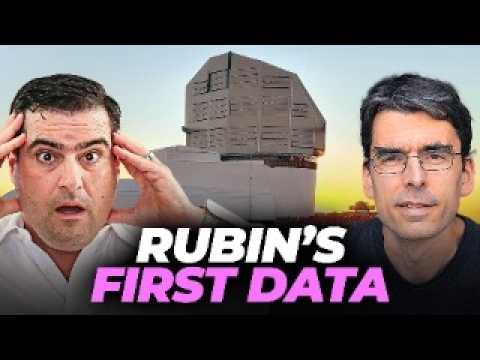
Dr Brian Keating • Please join my mailing list here 👉 https://briankeating.com/list to win a meteorite 💥 In this exclusive interview, Professor Mario Jurić reveals how the Vera Rubin Observatory accidentally discovered 2,000 asteroids in just 10 hours while testing its capabilities on the distant Virgo Cluster—transforming humanity's asteroid discovery rate from 20,000 per year globally to potentially over one million annually with a single telescope. Jurić explains how VRO's revolutionary multi-messenger astronomy capabilities will detect dark matter's effects and light simultaneously, automatically slewing to capture cosmic catastrophes like black hole collisions within 30 seconds of detection. From mapping dark matter in galaxy clusters 54 million light-years away to building Earth's first comprehensive planetary defense system against asteroid impacts, this conversation explores how one observatory is about to fundamentally change both our understanding of the universe and our ability to survive in it. — Key Takeaways: 00:00 Intro 03:10 Mario’s reaction to the first data 04:13 Democratizing astronomy and citizen science 06:38 Technical details and capabilities 11:28 First look: A fly-through of the Virgo Cluster 21:42 Rubin and the Lambda-CDM model 28:22 How faint a sensitivity can Rubin achieve 33:03 Asteroid discovery revolution 37:52 Challenges of data analysis 41:38 Astronomy and AI 46:34 What kinds of civilization-changing discoveries might be hiding in the data? 50:48 Outro — Additional resources: 🔹Skyviewer App: https://skyviewer.app/ 🔹First Images from NSF–DOE Vera C. Rubin Observatory: https://www.youtube.com/live/dF1g-Ru8mjM?si=Y3-lKTSjZAH_oGHl — ➡️ Follow me on your fav platforms: ✖️ Twitter: https://twitter.com/DrBrianKeating 🔔 YouTube: https://www.youtube.com/DrBrianKeating?sub_confirmation=1 📝 Join my mailing list: https://briankeating.com/list ✍️ Check out my blog: https://briankeating.com/cosmic-musings/ 🎙️ Follow my podcast: https://briankeating.com/podcast — Into the Impossible with Brian Keating is a podcast dedicated to all those who want to explore the universe within and beyond the known. Make sure to follow/subscribe so you never miss an episode! #intotheimpossible #briankeating #verarubinobservatory #mariojuric #darkmatter
Content Summary
This report is generated from research on the following videos, based on the requirements set in Video Deep Research.
Analyze selected videos,
My goal is 📑 Discover Content Intelligence
My role is 🎓 Teacher/Educator/Coach
I need: ⛰️ Learning pathway recommendations, 🤔 Learning difficulty assessment, 📝 Key concept summarization and concept mapping, 🌟 Important knowledge identification, ❓ Practice question generation from video content

https:...0fHk
Summary
1. Open Access Science for Citizen Discovery
2. Real-Time Planetary Defense and Asteroid Tracking
3. Visualizing Galactic Evolution and Dark Matter
Knowledge Snap
Ascent Stage 1: Time-Domain Astronomy
🎬 Related Clip
(3)
Video Title
01:40 - 04:13
Professor Jurić explains how software identifies time-varying and moving objects within the new observatory system.
10:59 - 18:59
The speaker notes that Mario specializes in time-domain astronomy and objects that could hit the Earth.
11:06 - 19:06
The discussion focuses on transient astronomy and tracking changes in the sky over short periods.
Ascent Stage 2: Data Democratization
🎬 Related Clip
(3)
Video Title
04:36 - 06:39
Brian Keating highlights that links to web browsers and resources are available for public use.
04:47 - 11:28
Mario explains that this observatory is one of the first to prioritize open science for the world.
00:47 - 02:52
Really becoming an evidence for dark matter with a gigapixel camera and unprecedented data analysis.
Ascent Stage 3: Galactic Evolution Dynamics
🎬 Related Clip
(3)
Video Title
19:22 - 21:25
The video displays a thin bridge of stars connecting two galaxies that are currently interacting.
19:39 - 21:41
The footage reveals shockwave shells of stars created during intense galactic interactions.
19:45 - 21:47
The narrator explains how billions of stars were shocked into specific configurations during galaxy collisions.
Ascent Stage 4: Cosmology and Dark Matter
🎬 Related Clip
(3)
Video Title
21:55 - 24:00
The host discusses the observatory's impact on the evolving understanding of the Lambda-CDM model.
22:29 - 24:29
The segment recalls that the telescope was originally referred to as the dark matter telescope.
26:07 - 28:10
Mario discusses the telescope's goal of achieving a better understanding of dark energy and cosmology.
Ascent Stage 5: Advanced Imaging Technology
🎬 Related Clip
(3)
Video Title
20:53 - 28:22
The scientist confirms that the observatory is an optical telescope with multiple bands for sensing.
41:11 - 46:34
The speaker lists the specific U G R I Z Y bands used to capture different light wavelengths.
21:12 - 28:22
The discussion covers how the telescope detects three levels of infrared light near one micron.
Ascent Stage 6: Planetary Defense Education
🎬 Related Clip
(3)
Video Title
00:17 - 02:22
The narrator explains that the technology helps identify asteroids that could potentially be Earth killers.
02:40 - 06:38
The interview reveals that an asteroid was discovered in just ten hours of operation.
21:41 - 28:22
The host notes that the telescope is excellent at finding comets and objects that move quickly.
Mapping the Future of Cosmic Observation
UCmXH_moPhfkqCk6S3b9RWuw
🔭
Observatory Milestone
00:36 - 02:40
The scientist introduces the Vera Rubin Observatory as a major leap forward for astronomical research and discovery.
🏔️
Physical Transition
00:29 - 02:29
Moving from digital models to a physical facility marks a monumental moment for the engineering and science teams.
🌐
Data Democratization
05:00 - 11:28
The mission prioritizes open access to data and software to encourage global participation in scientific discovery.
📸
Imaging Scale
07:42 - 09:42
The world's largest digital camera allows the telescope to capture immense detail across the southern sky.
🌌
Deep Space Targets
12:07 - 14:08
Initial data focuses on supermassive elliptical galaxies and their surroundings within the distant Virgo Cluster.
✨
Stellar Origins
16:30 - 18:32
Vibrant blue regions in captured imagery reveal where millions of new stars are currently forming.
🌑
Invisible Matter
23:40 - 25:44
Visible galaxy interactions provide essential clues about the behavior and presence of dark matter in space.
⏲️
Observation Speed
05:55 - 11:28
Short exposures allow the telescope to monitor changes across the sky with unprecedented frequency and depth.
Learning Pathway for Content Intelligence in Modern Astronomy
| Stage | Videos |
|---|---|
1. Institutional Foundations and Legacy | ng list here 👉 https://briankeating.com/list to win a meteorite 💥 In this exclusive interview, Professor Mario Jurić reveals how the Vera Rubin Observatory accidentally discovered 2,000 asteroids in just 10 hours while testing its capabilities on the distant Virgo Cluster—transforming humanity's asteroid discovery rate from 20,000 per year globally to potentially over one million annually with a single telescope. Jurić explains how VRO's revolutionary multi-messenger astronomy capabilities will detect dark matter's effects and light simultaneously, automatically slewing to capture cosmic catastrophes like black hole collisions within 30 seconds of detection. From mapping dark matter in galaxy clusters 54 million light-years away to building Earth's first comprehensive planetary defense system against asteroid impacts, this conversation explores how one observatory is about to fundamentally change both our understanding of the universe and our ability to survive in it. — Key Takeaways: 00:00 Intro 03:10 Mario’s reaction to the first data 04:13 Democratizing astronomy and citizen science 06:38 Technical details and capabilities 11:28 First look: A fly-through of the Virgo Cluster 21:42 Rubin and the Lambda-CDM model 28:22 How faint a sensitivity can Rubin achieve 33:03 Asteroid discovery revolution 37:52 Challenges of data analysis 41:38 Astronomy and AI 46:34 What kinds of civilization-changing discoveries might be hiding in the data? 50:48 Outro — Additional resources: 🔹Skyviewer App: https://skyviewer.app/ 🔹First Images from NSF–DOE Vera C. Rubin Observatory: https://www.youtube.com/live/dF1g-Ru8mjM?si=Y3-lKTSjZAH_oGHl — ➡️ Follow me on your fav platforms: ✖️ Twitter: https://twitter.com/DrBrianKeating 🔔 YouTube: https://www.youtube.com/DrBrianKeating?sub_confirmation=1 📝 Join my mailing list: https://briankeating.com/list ✍️ Check out my blog: https://briankeating.com/cosmic-musings/ 🎙️ Follow my podcast: https://briankeating.com/podcast — Into the Impossible with Brian Keating is a podcast dedicated to all those who want to explore the universe within and beyond the known. Make sure to follow/subscribe so you never miss an episode! #intotheimpossible #briankeating #verarubinobservatory #mariojuric #darkmatter |
2. Public Science and Open Access | ng list here 👉 https://briankeating.com/list to win a meteorite 💥 In this exclusive interview, Professor Mario Jurić reveals how the Vera Rubin Observatory accidentally discovered 2,000 asteroids in just 10 hours while testing its capabilities on the distant Virgo Cluster—transforming humanity's asteroid discovery rate from 20,000 per year globally to potentially over one million annually with a single telescope. Jurić explains how VRO's revolutionary multi-messenger astronomy capabilities will detect dark matter's effects and light simultaneously, automatically slewing to capture cosmic catastrophes like black hole collisions within 30 seconds of detection. From mapping dark matter in galaxy clusters 54 million light-years away to building Earth's first comprehensive planetary defense system against asteroid impacts, this conversation explores how one observatory is about to fundamentally change both our understanding of the universe and our ability to survive in it. — Key Takeaways: 00:00 Intro 03:10 Mario’s reaction to the first data 04:13 Democratizing astronomy and citizen science 06:38 Technical details and capabilities 11:28 First look: A fly-through of the Virgo Cluster 21:42 Rubin and the Lambda-CDM model 28:22 How faint a sensitivity can Rubin achieve 33:03 Asteroid discovery revolution 37:52 Challenges of data analysis 41:38 Astronomy and AI 46:34 What kinds of civilization-changing discoveries might be hiding in the data? 50:48 Outro — Additional resources: 🔹Skyviewer App: https://skyviewer.app/ 🔹First Images from NSF–DOE Vera C. Rubin Observatory: https://www.youtube.com/live/dF1g-Ru8mjM?si=Y3-lKTSjZAH_oGHl — ➡️ Follow me on your fav platforms: ✖️ Twitter: https://twitter.com/DrBrianKeating 🔔 YouTube: https://www.youtube.com/DrBrianKeating?sub_confirmation=1 📝 Join my mailing list: https://briankeating.com/list ✍️ Check out my blog: https://briankeating.com/cosmic-musings/ 🎙️ Follow my podcast: https://briankeating.com/podcast — Into the Impossible with Brian Keating is a podcast dedicated to all those who want to explore the universe within and beyond the known. Make sure to follow/subscribe so you never miss an episode! #intotheimpossible #briankeating #verarubinobservatory #mariojuric #darkmatter |
3. Large-Scale Structure Visualization | ng list here 👉 https://briankeating.com/list to win a meteorite 💥 In this exclusive interview, Professor Mario Jurić reveals how the Vera Rubin Observatory accidentally discovered 2,000 asteroids in just 10 hours while testing its capabilities on the distant Virgo Cluster—transforming humanity's asteroid discovery rate from 20,000 per year globally to potentially over one million annually with a single telescope. Jurić explains how VRO's revolutionary multi-messenger astronomy capabilities will detect dark matter's effects and light simultaneously, automatically slewing to capture cosmic catastrophes like black hole collisions within 30 seconds of detection. From mapping dark matter in galaxy clusters 54 million light-years away to building Earth's first comprehensive planetary defense system against asteroid impacts, this conversation explores how one observatory is about to fundamentally change both our understanding of the universe and our ability to survive in it. — Key Takeaways: 00:00 Intro 03:10 Mario’s reaction to the first data 04:13 Democratizing astronomy and citizen science 06:38 Technical details and capabilities 11:28 First look: A fly-through of the Virgo Cluster 21:42 Rubin and the Lambda-CDM model 28:22 How faint a sensitivity can Rubin achieve 33:03 Asteroid discovery revolution 37:52 Challenges of data analysis 41:38 Astronomy and AI 46:34 What kinds of civilization-changing discoveries might be hiding in the data? 50:48 Outro — Additional resources: 🔹Skyviewer App: https://skyviewer.app/ 🔹First Images from NSF–DOE Vera C. Rubin Observatory: https://www.youtube.com/live/dF1g-Ru8mjM?si=Y3-lKTSjZAH_oGHl — ➡️ Follow me on your fav platforms: ✖️ Twitter: https://twitter.com/DrBrianKeating 🔔 YouTube: https://www.youtube.com/DrBrianKeating?sub_confirmation=1 📝 Join my mailing list: https://briankeating.com/list ✍️ Check out my blog: https://briankeating.com/cosmic-musings/ 🎙️ Follow my podcast: https://briankeating.com/podcast — Into the Impossible with Brian Keating is a podcast dedicated to all those who want to explore the universe within and beyond the known. Make sure to follow/subscribe so you never miss an episode! #intotheimpossible #briankeating #verarubinobservatory #mariojuric #darkmatter |
4. Stellar Interactions and Simulations | ng list here 👉 https://briankeating.com/list to win a meteorite 💥 In this exclusive interview, Professor Mario Jurić reveals how the Vera Rubin Observatory accidentally discovered 2,000 asteroids in just 10 hours while testing its capabilities on the distant Virgo Cluster—transforming humanity's asteroid discovery rate from 20,000 per year globally to potentially over one million annually with a single telescope. Jurić explains how VRO's revolutionary multi-messenger astronomy capabilities will detect dark matter's effects and light simultaneously, automatically slewing to capture cosmic catastrophes like black hole collisions within 30 seconds of detection. From mapping dark matter in galaxy clusters 54 million light-years away to building Earth's first comprehensive planetary defense system against asteroid impacts, this conversation explores how one observatory is about to fundamentally change both our understanding of the universe and our ability to survive in it. — Key Takeaways: 00:00 Intro 03:10 Mario’s reaction to the first data 04:13 Democratizing astronomy and citizen science 06:38 Technical details and capabilities 11:28 First look: A fly-through of the Virgo Cluster 21:42 Rubin and the Lambda-CDM model 28:22 How faint a sensitivity can Rubin achieve 33:03 Asteroid discovery revolution 37:52 Challenges of data analysis 41:38 Astronomy and AI 46:34 What kinds of civilization-changing discoveries might be hiding in the data? 50:48 Outro — Additional resources: 🔹Skyviewer App: https://skyviewer.app/ 🔹First Images from NSF–DOE Vera C. Rubin Observatory: https://www.youtube.com/live/dF1g-Ru8mjM?si=Y3-lKTSjZAH_oGHl — ➡️ Follow me on your fav platforms: ✖️ Twitter: https://twitter.com/DrBrianKeating 🔔 YouTube: https://www.youtube.com/DrBrianKeating?sub_confirmation=1 📝 Join my mailing list: https://briankeating.com/list ✍️ Check out my blog: https://briankeating.com/cosmic-musings/ 🎙️ Follow my podcast: https://briankeating.com/podcast — Into the Impossible with Brian Keating is a podcast dedicated to all those who want to explore the universe within and beyond the known. Make sure to follow/subscribe so you never miss an episode! #intotheimpossible #briankeating #verarubinobservatory #mariojuric #darkmatter |
5. Cosmological Models and Dark Energy | ng list here 👉 https://briankeating.com/list to win a meteorite 💥 In this exclusive interview, Professor Mario Jurić reveals how the Vera Rubin Observatory accidentally discovered 2,000 asteroids in just 10 hours while testing its capabilities on the distant Virgo Cluster—transforming humanity's asteroid discovery rate from 20,000 per year globally to potentially over one million annually with a single telescope. Jurić explains how VRO's revolutionary multi-messenger astronomy capabilities will detect dark matter's effects and light simultaneously, automatically slewing to capture cosmic catastrophes like black hole collisions within 30 seconds of detection. From mapping dark matter in galaxy clusters 54 million light-years away to building Earth's first comprehensive planetary defense system against asteroid impacts, this conversation explores how one observatory is about to fundamentally change both our understanding of the universe and our ability to survive in it. — Key Takeaways: 00:00 Intro 03:10 Mario’s reaction to the first data 04:13 Democratizing astronomy and citizen science 06:38 Technical details and capabilities 11:28 First look: A fly-through of the Virgo Cluster 21:42 Rubin and the Lambda-CDM model 28:22 How faint a sensitivity can Rubin achieve 33:03 Asteroid discovery revolution 37:52 Challenges of data analysis 41:38 Astronomy and AI 46:34 What kinds of civilization-changing discoveries might be hiding in the data? 50:48 Outro — Additional resources: 🔹Skyviewer App: https://skyviewer.app/ 🔹First Images from NSF–DOE Vera C. Rubin Observatory: https://www.youtube.com/live/dF1g-Ru8mjM?si=Y3-lKTSjZAH_oGHl — ➡️ Follow me on your fav platforms: ✖️ Twitter: https://twitter.com/DrBrianKeating 🔔 YouTube: https://www.youtube.com/DrBrianKeating?sub_confirmation=1 📝 Join my mailing list: https://briankeating.com/list ✍️ Check out my blog: https://briankeating.com/cosmic-musings/ 🎙️ Follow my podcast: https://briankeating.com/podcast — Into the Impossible with Brian Keating is a podcast dedicated to all those who want to explore the universe within and beyond the known. Make sure to follow/subscribe so you never miss an episode! #intotheimpossible #briankeating #verarubinobservatory #mariojuric #darkmatter |
6. Planetary Defense and Asteroid Detection | ng list here 👉 https://briankeating.com/list to win a meteorite 💥 In this exclusive interview, Professor Mario Jurić reveals how the Vera Rubin Observatory accidentally discovered 2,000 asteroids in just 10 hours while testing its capabilities on the distant Virgo Cluster—transforming humanity's asteroid discovery rate from 20,000 per year globally to potentially over one million annually with a single telescope. Jurić explains how VRO's revolutionary multi-messenger astronomy capabilities will detect dark matter's effects and light simultaneously, automatically slewing to capture cosmic catastrophes like black hole collisions within 30 seconds of detection. From mapping dark matter in galaxy clusters 54 million light-years away to building Earth's first comprehensive planetary defense system against asteroid impacts, this conversation explores how one observatory is about to fundamentally change both our understanding of the universe and our ability to survive in it. — Key Takeaways: 00:00 Intro 03:10 Mario’s reaction to the first data 04:13 Democratizing astronomy and citizen science 06:38 Technical details and capabilities 11:28 First look: A fly-through of the Virgo Cluster 21:42 Rubin and the Lambda-CDM model 28:22 How faint a sensitivity can Rubin achieve 33:03 Asteroid discovery revolution 37:52 Challenges of data analysis 41:38 Astronomy and AI 46:34 What kinds of civilization-changing discoveries might be hiding in the data? 50:48 Outro — Additional resources: 🔹Skyviewer App: https://skyviewer.app/ 🔹First Images from NSF–DOE Vera C. Rubin Observatory: https://www.youtube.com/live/dF1g-Ru8mjM?si=Y3-lKTSjZAH_oGHl — ➡️ Follow me on your fav platforms: ✖️ Twitter: https://twitter.com/DrBrianKeating 🔔 YouTube: https://www.youtube.com/DrBrianKeating?sub_confirmation=1 📝 Join my mailing list: https://briankeating.com/list ✍️ Check out my blog: https://briankeating.com/cosmic-musings/ 🎙️ Follow my podcast: https://briankeating.com/podcast — Into the Impossible with Brian Keating is a podcast dedicated to all those who want to explore the universe within and beyond the known. Make sure to follow/subscribe so you never miss an episode! #intotheimpossible #briankeating #verarubinobservatory #mariojuric #darkmatter |
Detailed Findings and Insights
1. Commissioning Efficiency
🎬 Related Clip
(2)
Video Title
49:02 - 52:11
The scientist explains the difficulty and speed of tuning the telescope before data began to flow.
08:36 - 10:40
The team managed to get the telescope tuned up quickly for its first images of the sky.
2. Globular Cluster Density
🎬 Related Clip
(2)
Video Title
14:47 - 16:48
The host compares the 6,000 globular clusters in M49 to the 150 in the Milky Way.
14:56 - 16:56
Mario points out that individual dots in the galaxy images are actually dense globular star clusters.
3. Redshift Color Indicators
🎬 Related Clip
(2)
Video Title
20:27 - 28:22
The narrator notes that red colors in deep images often signify distance rather than intrinsic color.
20:34 - 28:22
The narrator describes how red dots in images indicate distant clusters of galaxies due to redshift.
4. Stellar Shockwave configuration
🎬 Related Clip
(2)
Video Title
19:22 - 21:25
The footage shows a thin bridge of stars connecting two galaxies that are currently interacting.
19:39 - 21:41
The footage reveals shockwave shells of stars created during intense galactic interactions.
5. Vera Rubin’s Historical Impact
🎬 Related Clip
(2)
Video Title
00:36 - 02:40
The interview highlights Vera Rubin's historical role and why naming the observatory after her was logical.
28:17 - 33:03
The narrator describes Vera Rubin as a phenomenal person who opened the field to more people.
6. Multi-Filter Visible Spectrum
🎬 Related Clip
(2)
Video Title
20:53 - 28:22
The expert details how the telescope covers the entire visible spectrum using six specific bands.
21:19 - 28:22
The guest explains that the wideband filters allow the system to cover the entire visible spectrum.
