
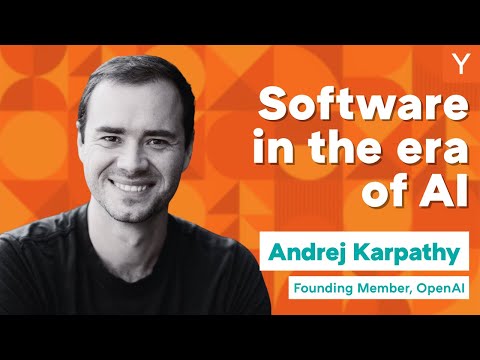
Y Combinator • Andrej Karpathy: Software Is Changing (Again)
Content Summary
This report is generated from research on the following videos, based on the requirements set in Video Deep Research.
Analyze selected videos,
My goal is 📑 Discover Content Intelligence
My role is 📚 Student/Learner/Researcher
I need: 📖 Academic source validation and credibility check, 🛤️ Learning pathway recommendations, 📋 Study guide creation with practice questions and quiz generation, 🤔 Knowledge gap identification, 📝 Key concept summarization and concept mapping


https:...PEtQ
Summary
1. The Rise of Software 3.0 and Vibe Coding
2. Navigating the Psychology of Large Language Models
3. Architecting the Future of AI Agents and Infrastructure
Knowledge Snap
Concept 1: Evolution of Software Paradigms
🎬 Related Clip
(3)
Video Title
01:35 - 03:39
The speaker introduces the term software 2.0 to describe a new type of software.
01:42 - 03:46
Software 1.0 is code written for computers while software 2.0 involves neural network weights.
03:18 - 06:10
The presenter explains that prompts are programs and natural language is the new programming interface.
Concept 2: LLM Psychological Frameworks
🎬 Related Clip
(3)
Video Title
14:50 - 16:55
The speaker defines large language models as stochastic simulations of people using an autoregressive transformer.
16:11 - 18:15
Artificial intelligence models frequently hallucinate and lack a perfect internal model of self-knowledge.
16:22 - 18:22
Models exhibit superhuman problem solving but make mistakes that no human would ever make.
Concept 3: Collaborative Verification Loops
🎬 Related Clip
(3)
Video Title
28:41 - 33:39
AI performs generation while humans perform verification in a loop that should be accelerated.
25:42 - 27:52
The speaker emphasizes keeping the artificial intelligence on a leash through human auditing.
23:11 - 26:00
Humans must ensure that AI systems are not introducing bugs or creating security issues.
Concept 4: Modular Autonomy Structures
🎬 Related Clip
(3)
Video Title
20:21 - 22:25
The autonomy slider allows users to control the level of AI assistance in applications.
20:46 - 22:51
The user remains in charge of the autonomy slider depending on the complexity of the task.
21:22 - 23:22
Varying levels of autonomy are given up by users when interacting with different research tools.
Concept 5: Natural Language Accessibility
🎬 Related Clip
(3)
Video Title
03:25 - 06:10
Prompts are written in English which serves as a very interesting and remarkable programming language.
04:09 - 06:10
The speaker highlights the use of native English as a remarkable new programming paradigm.
29:19 - 31:24
Everyone becomes a programmer because natural language like English is now the primary programming interface.
Concept 6: LLM Infrastructure Analogies
🎬 Related Clip
(3)
Video Title
03:06 - 06:10
Large language models currently possess many of the fundamental properties found in utility services.
08:03 - 10:09
The speaker argues that large language models also share certain properties with semiconductor fabs.
09:12 - 14:39
There are strong analogies between large language models and modern computer operating systems.
Evolution of Software and the Advent of the Large Language Model Operating System
Andrej Karpathy: Software Is Changing (Again)
UCcefcZRL2oaA_uBNeo5UOWg
🚀
Software in the Modern Era
00:22 - 04:40
The speaker introduces the unique time for students to enter the rapidly changing software industry.
🔢
Defining Software Generations
01:48 - 03:51
Traditional code evolves into neural network weights and eventually into language model prompts.
🗣️
Programming via Natural Language
03:18 - 06:10
Native languages like English become the primary interface for instructing new types of computers.
💻
The Emerging Digital Environment
10:09 - 14:39
Complex software ecosystems are shaping up to mirror historical computing structures like operating systems.
🧠
Simulated Human Intelligence
14:50 - 16:55
Models trained on human data exhibit emergent psychology, displaying both brilliance and fallibility.
🛠️
Architecting Intelligent Tools
19:31 - 21:33
New applications orchestrate multiple background processes to simplify complex user interactions.
🤝
Fast Collaboration Loops
22:20 - 26:00
Efficiency depends on the speed at which humans can verify machine-generated results.
🎨
Universal Accessibility
29:19 - 31:24
The democratization of programming allows anyone with language skills to create functional software.
Learning Pathway for Navigating the Era of Software 3.0
| Stage | Videos |
|---|---|
1. Distinguishing Programming Paradigms | Andrej Karpathy: Software Is Changing (Again) |
2. Understanding the Operating System Analogy | Andrej Karpathy: Software Is Changing (Again) |
3. Analyzing Model Psychology | Andrej Karpathy: Software Is Changing (Again) |
4. Implementing Partial Autonomy | Andrej Karpathy: Software Is Changing (Again) |
5. Optimizing the Verification Loop | Andrej Karpathy: Software Is Changing (Again) |
6. Expanding Accessibility Through Vibe Coding | Andrej Karpathy: Software Is Changing (Again) |
Detailed Findings and Insights
1. Context as Working Memory
🎬 Related Clip
(2)
Video Title
17:06 - 23:40
The speaker explains that context windows serve as working memory for large language models.
17:27 - 23:40
Model weights are fixed and context windows are cleared which presents challenges for long-term tasks.
2. Visual GUI for Auditing
🎬 Related Clip
(2)
Video Title
22:45 - 26:00
Graphical interfaces are useful for auditing systems and providing visual representations of AI work.
20:08 - 22:14
Visual diffs with color coding make it much easier for humans to audit changes.
3. The Decade of Agents
🎬 Related Clip
(2)
Video Title
29:49 - 31:55
The speaker suggests that the next ten years will be defined by the development of agents.
27:03 - 29:06
Twelve years later the industry is still working on autonomy and driving agents for vehicles.
4. Infrastructure Time Sharing
🎬 Related Clip
(2)
Video Title
14:06 - 18:22
Models are currently available through time sharing and distributed like a standard utility service.
11:22 - 13:22
Time sharing is used because most users do not have full utilization of cloud computers.
5. Specific App Orchestration
🎬 Related Clip
(2)
Video Title
19:31 - 21:33
Applications orchestrate multiple calls to different large language models under the hood for the user.
03:06 - 06:10
Certain research tools package information and orchestrate multiple large language models for complex queries.
6. Education through Artifacts
🎬 Related Clip
(2)
Video Title
25:37 - 27:52
A syllabus provides a progression of projects that helps keep the AI focused and on track.
25:24 - 27:52
Separate applications for teachers and students can use intermediate artifacts to ensure course consistency.
