
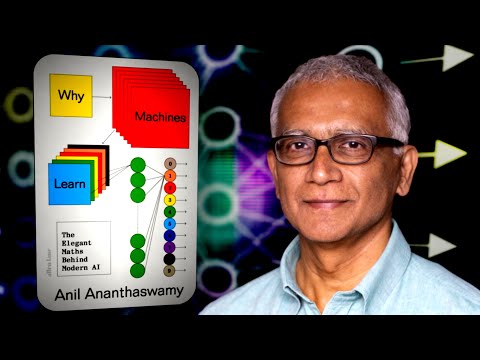
Machine Learning Street Talk • Anil Ananthaswamy is an award-winning science writer and former staff writer and deputy news editor for the London-based New Scientist magazine. Machine learning systems are making life-altering decisions for us: approving mortgage loans, determining whether a tumor is cancerous, or deciding if someone gets bail. They now influence developments and discoveries in chemistry, biology, and physics—the study of genomes, extrasolar planets, even the intricacies of quantum systems. And all this before large language models such as ChatGPT came on the scene. We are living through a revolution in machine learning-powered AI that shows no signs of slowing down. This technology is based on relatively simple mathematical ideas, some of which go back centuries, including linear algebra and calculus, the stuff of seventeenth- and eighteenth-century mathematics. It took the birth and advancement of computer science and the kindling of 1990s computer chips designed for video games to ignite the explosion of AI that we see today. In this enlightening book, Anil Ananthaswamy explains the fundamental math behind machine learning, while suggesting intriguing links between artificial and natural intelligence. Might the same math underpin them both? As Ananthaswamy resonantly concludes, to make safe and effective use of artificial intelligence, we need to understand its profound capabilities and limitations, the clues to which lie in the math that makes machine learning possible. Why Machines Learn: The Elegant Math Behind Modern AI: https://amzn.to/3UAWX3D https://anilananthaswamy.com/ Sponsor message: DO YOU WANT WORK ON ARC with the MindsAI team (current ARC winners)? Interested? Apply for an ML research position: benjamin@tufa.ai (JUST ADDED!) SHOWNOTES: https://www.dropbox.com/scl/fi/wpv22m5jxyiqr6pqfkzwz/anil.pdf?rlkey=9c233jo5armr548ctwo419n6p&st=xzhahtje&dl=0 Chapters: 1. ML Fundamentals and Prerequisites [00:00:00] 1.1 Differences Between Human and Machine Learning [00:00:35] 1.2 Mathematical Prerequisites and Societal Impact of ML [00:02:20] 1.3 Author's Journey and Book Background [00:11:30] 1.4 Mathematical Foundations and Core ML Concepts [00:21:45] 1.5 Bias-Variance Tradeoff and Modern Deep Learning 2. Deep Learning Architecture [00:29:05] 2.1 Double Descent and Overparameterization in Deep Learning [00:32:40] 2.2 Mathematical Foundations and Self-Supervised Learning [00:40:05] 2.3 High-Dimensional Spaces and Model Architecture [00:52:55] 2.4 Historical Development of Backpropagation 3. AI Understanding and Limitations [00:59:13] 3.1 Pattern Matching vs Human Reasoning in ML Models [01:00:20] 3.2 Mathematical Foundations and Pattern Recognition in AI [01:04:08] 3.3 LLM Reliability and Machine Understanding Debate [01:12:50] 3.4 Historical Development of Deep Learning Technologies [01:15:21] 3.5 Alternative AI Approaches and Bio-inspired Methods 4. Ethical and Neurological Perspectives [01:24:32] 4.1 Neural Network Scaling and Mathematical Limitations [01:31:12] 4.2 AI Ethics and Societal Impact [01:38:30] 4.3 Consciousness and Neurological Conditions [01:46:17] 4.4 Body Ownership and Agency in Neuroscience
Content Summary
This report is generated from research on the following videos, based on the requirements set in Video Deep Research.
Analyze selected videos,
My goal is 📑 Discover Content Intelligence
My role is 📚 Student/Learner/Researcher
I need: 🤔 Knowledge gap identification, 📖 Academic source validation and credibility check, 📝 Key concept summarization and concept mapping, 📋 Study guide creation with practice questions and quiz generation


https:...YBSo
Summary
1. Foundational Math and the Pattern Matching Reality
2. Biological Efficiency and Self-Supervised Learning
3. Validation Hurdles and the Mirage of Machine Reasoning
Knowledge Snap
Method 1: Mathematical Foundations of Machine Learning
🎬 Related Clip
(3)
Video Title
06:10 - 08:12
Anil Ananthaswamy discusses how fundamental math and computer science advancements ignited the modern explosion of AI.
11:36 - 13:40
Essential prerequisites for machine learning include basics of probability, statistics, and a bit of optimization theory.
01:55 - 09:55
Modern machine learning involves many people using algorithms without understanding the underlying mathematical reasons for performance.
Method 2: Self-Supervised Learning Mechanisms
🎬 Related Clip
(3)
Video Title
30:42 - 32:43
Self-supervised learning involves training a model using the data itself as the label for human-free training.
00:40 - 08:40
Machines learn by predicting masked portions of images to understand the underlying structure of visual data.
33:57 - 36:05
Iterative error correction helps the machine eventually figure out the missing parts of its data inputs.
Method 3: Evolution of Backpropagation and Feature Learning
🎬 Related Clip
(3)
Video Title
53:12 - 55:14
The success of deep neural networks relies on the straightforward yet powerful idea behind the backpropagation algorithm.
53:36 - 55:43
Neural networks determine error by comparing their actual output against the expected correct output for training.
57:56 - 01:00:20
A significant publication in 1986 popularized the training of neural networks with hidden layers using backpropagation.
Method 4: Vector Embeddings in High-Dimensional Spaces
🎬 Related Clip
(3)
Video Title
09:36 - 17:36
Kernel functions project data into much higher or even infinite-dimensional spaces for more effective pattern recognition.
17:48 - 19:49
The k-nearest neighbor algorithm works by plotting data points into a high-dimensional space for similarity checks.
41:17 - 43:19
Unknown images are turned into vectors to determine if they are closer to dog or cat clusters.
Method 5: Pattern Matching and Probabilistic Prediction
🎬 Related Clip
(3)
Video Title
00:55 - 08:55
The speaker notes that current machines are primarily performing very sophisticated pattern matching for their tasks.
13:32 - 15:37
Large language models like ChatGPT can hallucinate because they rely on patterns rather than deep reasoning.
01:05:36 - 01:07:36
Internal probabilities allow the machine to make its best guess for the next token in a sequence.
Method 6: Inductive Biases and Bio-Inspired Design
🎬 Related Clip
(3)
Video Title
50:50 - 52:51
Convolutional neural networks were inspired by scientific understanding of the human visual processing system.
51:36 - 59:13
The human visual system has built-in invariance that allows it to detect edges despite rotation or translation.
01:19:28 - 01:21:36
Early convolutional neural networks utilized inductive biases to build prior knowledge into the machine learning models.
The Mathematical Evolution of Machine Intelligence
UCMLtBahI5DMrt0NPvDSoIRQ
🧠
Learning without Labels
00:00 - 02:20
Exploration of how human brains naturally learn through evolution compared to machine processes.
✍️
Author's Career Transition
02:39 - 04:42
Anil Ananthaswamy discusses merging his passions for science and professional writing into a new career.
➕
Foundational Math Disciplines
10:44 - 18:44
Identifying the essential mathematical fields required to grasp the basics of modern machine learning.
⚖️
Model Complexity Tradeoffs
26:26 - 28:33
Understanding the classic balance between model simplicity and parameter tuning in statistical learning.
🔄
Self-Supervised Training
30:42 - 32:43
Reviewing the shift toward training models using data as its own internal labeling system.
📜
Backpropagation Milestones
53:12 - 55:14
A historical look at the development and impact of the backpropagation algorithm in neural networks.
⚠️
Pattern Matching Limitations
01:04:06 - 01:12:06
How sophisticated pattern matching in ChatGPT can lead to incorrect answers and internal hallucinations.
📈
Neural Network Scaling
01:24:32 - 01:31:12
Discussion on the mathematical backstops and scaling behaviors of increasingly large artificial systems.
Learning Pathway for Mastering Content Analysis
| Stage | Videos |
|---|---|
1. Converting Raw Data into Vectors | an award-winning science writer and former staff writer and deputy news editor for the London-based New Scientist magazine. Machine learning systems are making life-altering decisions for us: approving mortgage loans, determining whether a tumor is cancerous, or deciding if someone gets bail. They now influence developments and discoveries in chemistry, biology, and physics—the study of genomes, extrasolar planets, even the intricacies of quantum systems. And all this before large language models such as ChatGPT came on the scene. We are living through a revolution in machine learning-powered AI that shows no signs of slowing down. This technology is based on relatively simple mathematical ideas, some of which go back centuries, including linear algebra and calculus, the stuff of seventeenth- and eighteenth-century mathematics. It took the birth and advancement of computer science and the kindling of 1990s computer chips designed for video games to ignite the explosion of AI that we see today. In this enlightening book, Anil Ananthaswamy explains the fundamental math behind machine learning, while suggesting intriguing links between artificial and natural intelligence. Might the same math underpin them both? As Ananthaswamy resonantly concludes, to make safe and effective use of artificial intelligence, we need to understand its profound capabilities and limitations, the clues to which lie in the math that makes machine learning possible. Why Machines Learn: The Elegant Math Behind Modern AI: https://amzn.to/3UAWX3D https://anilananthaswamy.com/ Sponsor message: DO YOU WANT WORK ON ARC with the MindsAI team (current ARC winners)? Interested? Apply for an ML research position: benjamin@tufa.ai (JUST ADDED!) SHOWNOTES: https://www.dropbox.com/scl/fi/wpv22m5jxyiqr6pqfkzwz/anil.pdf?rlkey=9c233jo5armr548ctwo419n6p&st=xzhahtje&dl=0 Chapters: 1. ML Fundamentals and Prerequisites [00:00:00] 1.1 Differences Between Human and Machine Learning [00:00:35] 1.2 Mathematical Prerequisites and Societal Impact of ML [00:02:20] 1.3 Author's Journey and Book Background [00:11:30] 1.4 Mathematical Foundations and Core ML Concepts [00:21:45] 1.5 Bias-Variance Tradeoff and Modern Deep Learning 2. Deep Learning Architecture [00:29:05] 2.1 Double Descent and Overparameterization in Deep Learning [00:32:40] 2.2 Mathematical Foundations and Self-Supervised Learning [00:40:05] 2.3 High-Dimensional Spaces and Model Architecture [00:52:55] 2.4 Historical Development of Backpropagation 3. AI Understanding and Limitations [00:59:13] 3.1 Pattern Matching vs Human Reasoning in ML Models [01:00:20] 3.2 Mathematical Foundations and Pattern Recognition in AI [01:04:08] 3.3 LLM Reliability and Machine Understanding Debate [01:12:50] 3.4 Historical Development of Deep Learning Technologies [01:15:21] 3.5 Alternative AI Approaches and Bio-inspired Methods 4. Ethical and Neurological Perspectives [01:24:32] 4.1 Neural Network Scaling and Mathematical Limitations [01:31:12] 4.2 AI Ethics and Societal Impact [01:38:30] 4.3 Consciousness and Neurological Conditions [01:46:17] 4.4 Body Ownership and Agency in Neuroscience |
2. Applying Biological Visual Priors | an award-winning science writer and former staff writer and deputy news editor for the London-based New Scientist magazine. Machine learning systems are making life-altering decisions for us: approving mortgage loans, determining whether a tumor is cancerous, or deciding if someone gets bail. They now influence developments and discoveries in chemistry, biology, and physics—the study of genomes, extrasolar planets, even the intricacies of quantum systems. And all this before large language models such as ChatGPT came on the scene. We are living through a revolution in machine learning-powered AI that shows no signs of slowing down. This technology is based on relatively simple mathematical ideas, some of which go back centuries, including linear algebra and calculus, the stuff of seventeenth- and eighteenth-century mathematics. It took the birth and advancement of computer science and the kindling of 1990s computer chips designed for video games to ignite the explosion of AI that we see today. In this enlightening book, Anil Ananthaswamy explains the fundamental math behind machine learning, while suggesting intriguing links between artificial and natural intelligence. Might the same math underpin them both? As Ananthaswamy resonantly concludes, to make safe and effective use of artificial intelligence, we need to understand its profound capabilities and limitations, the clues to which lie in the math that makes machine learning possible. Why Machines Learn: The Elegant Math Behind Modern AI: https://amzn.to/3UAWX3D https://anilananthaswamy.com/ Sponsor message: DO YOU WANT WORK ON ARC with the MindsAI team (current ARC winners)? Interested? Apply for an ML research position: benjamin@tufa.ai (JUST ADDED!) SHOWNOTES: https://www.dropbox.com/scl/fi/wpv22m5jxyiqr6pqfkzwz/anil.pdf?rlkey=9c233jo5armr548ctwo419n6p&st=xzhahtje&dl=0 Chapters: 1. ML Fundamentals and Prerequisites [00:00:00] 1.1 Differences Between Human and Machine Learning [00:00:35] 1.2 Mathematical Prerequisites and Societal Impact of ML [00:02:20] 1.3 Author's Journey and Book Background [00:11:30] 1.4 Mathematical Foundations and Core ML Concepts [00:21:45] 1.5 Bias-Variance Tradeoff and Modern Deep Learning 2. Deep Learning Architecture [00:29:05] 2.1 Double Descent and Overparameterization in Deep Learning [00:32:40] 2.2 Mathematical Foundations and Self-Supervised Learning [00:40:05] 2.3 High-Dimensional Spaces and Model Architecture [00:52:55] 2.4 Historical Development of Backpropagation 3. AI Understanding and Limitations [00:59:13] 3.1 Pattern Matching vs Human Reasoning in ML Models [01:00:20] 3.2 Mathematical Foundations and Pattern Recognition in AI [01:04:08] 3.3 LLM Reliability and Machine Understanding Debate [01:12:50] 3.4 Historical Development of Deep Learning Technologies [01:15:21] 3.5 Alternative AI Approaches and Bio-inspired Methods 4. Ethical and Neurological Perspectives [01:24:32] 4.1 Neural Network Scaling and Mathematical Limitations [01:31:12] 4.2 AI Ethics and Societal Impact [01:38:30] 4.3 Consciousness and Neurological Conditions [01:46:17] 4.4 Body Ownership and Agency in Neuroscience |
3. Extracting Statistical Correlations | an award-winning science writer and former staff writer and deputy news editor for the London-based New Scientist magazine. Machine learning systems are making life-altering decisions for us: approving mortgage loans, determining whether a tumor is cancerous, or deciding if someone gets bail. They now influence developments and discoveries in chemistry, biology, and physics—the study of genomes, extrasolar planets, even the intricacies of quantum systems. And all this before large language models such as ChatGPT came on the scene. We are living through a revolution in machine learning-powered AI that shows no signs of slowing down. This technology is based on relatively simple mathematical ideas, some of which go back centuries, including linear algebra and calculus, the stuff of seventeenth- and eighteenth-century mathematics. It took the birth and advancement of computer science and the kindling of 1990s computer chips designed for video games to ignite the explosion of AI that we see today. In this enlightening book, Anil Ananthaswamy explains the fundamental math behind machine learning, while suggesting intriguing links between artificial and natural intelligence. Might the same math underpin them both? As Ananthaswamy resonantly concludes, to make safe and effective use of artificial intelligence, we need to understand its profound capabilities and limitations, the clues to which lie in the math that makes machine learning possible. Why Machines Learn: The Elegant Math Behind Modern AI: https://amzn.to/3UAWX3D https://anilananthaswamy.com/ Sponsor message: DO YOU WANT WORK ON ARC with the MindsAI team (current ARC winners)? Interested? Apply for an ML research position: benjamin@tufa.ai (JUST ADDED!) SHOWNOTES: https://www.dropbox.com/scl/fi/wpv22m5jxyiqr6pqfkzwz/anil.pdf?rlkey=9c233jo5armr548ctwo419n6p&st=xzhahtje&dl=0 Chapters: 1. ML Fundamentals and Prerequisites [00:00:00] 1.1 Differences Between Human and Machine Learning [00:00:35] 1.2 Mathematical Prerequisites and Societal Impact of ML [00:02:20] 1.3 Author's Journey and Book Background [00:11:30] 1.4 Mathematical Foundations and Core ML Concepts [00:21:45] 1.5 Bias-Variance Tradeoff and Modern Deep Learning 2. Deep Learning Architecture [00:29:05] 2.1 Double Descent and Overparameterization in Deep Learning [00:32:40] 2.2 Mathematical Foundations and Self-Supervised Learning [00:40:05] 2.3 High-Dimensional Spaces and Model Architecture [00:52:55] 2.4 Historical Development of Backpropagation 3. AI Understanding and Limitations [00:59:13] 3.1 Pattern Matching vs Human Reasoning in ML Models [01:00:20] 3.2 Mathematical Foundations and Pattern Recognition in AI [01:04:08] 3.3 LLM Reliability and Machine Understanding Debate [01:12:50] 3.4 Historical Development of Deep Learning Technologies [01:15:21] 3.5 Alternative AI Approaches and Bio-inspired Methods 4. Ethical and Neurological Perspectives [01:24:32] 4.1 Neural Network Scaling and Mathematical Limitations [01:31:12] 4.2 AI Ethics and Societal Impact [01:38:30] 4.3 Consciousness and Neurological Conditions [01:46:17] 4.4 Body Ownership and Agency in Neuroscience |
4. Predicting Model Performance | an award-winning science writer and former staff writer and deputy news editor for the London-based New Scientist magazine. Machine learning systems are making life-altering decisions for us: approving mortgage loans, determining whether a tumor is cancerous, or deciding if someone gets bail. They now influence developments and discoveries in chemistry, biology, and physics—the study of genomes, extrasolar planets, even the intricacies of quantum systems. And all this before large language models such as ChatGPT came on the scene. We are living through a revolution in machine learning-powered AI that shows no signs of slowing down. This technology is based on relatively simple mathematical ideas, some of which go back centuries, including linear algebra and calculus, the stuff of seventeenth- and eighteenth-century mathematics. It took the birth and advancement of computer science and the kindling of 1990s computer chips designed for video games to ignite the explosion of AI that we see today. In this enlightening book, Anil Ananthaswamy explains the fundamental math behind machine learning, while suggesting intriguing links between artificial and natural intelligence. Might the same math underpin them both? As Ananthaswamy resonantly concludes, to make safe and effective use of artificial intelligence, we need to understand its profound capabilities and limitations, the clues to which lie in the math that makes machine learning possible. Why Machines Learn: The Elegant Math Behind Modern AI: https://amzn.to/3UAWX3D https://anilananthaswamy.com/ Sponsor message: DO YOU WANT WORK ON ARC with the MindsAI team (current ARC winners)? Interested? Apply for an ML research position: benjamin@tufa.ai (JUST ADDED!) SHOWNOTES: https://www.dropbox.com/scl/fi/wpv22m5jxyiqr6pqfkzwz/anil.pdf?rlkey=9c233jo5armr548ctwo419n6p&st=xzhahtje&dl=0 Chapters: 1. ML Fundamentals and Prerequisites [00:00:00] 1.1 Differences Between Human and Machine Learning [00:00:35] 1.2 Mathematical Prerequisites and Societal Impact of ML [00:02:20] 1.3 Author's Journey and Book Background [00:11:30] 1.4 Mathematical Foundations and Core ML Concepts [00:21:45] 1.5 Bias-Variance Tradeoff and Modern Deep Learning 2. Deep Learning Architecture [00:29:05] 2.1 Double Descent and Overparameterization in Deep Learning [00:32:40] 2.2 Mathematical Foundations and Self-Supervised Learning [00:40:05] 2.3 High-Dimensional Spaces and Model Architecture [00:52:55] 2.4 Historical Development of Backpropagation 3. AI Understanding and Limitations [00:59:13] 3.1 Pattern Matching vs Human Reasoning in ML Models [01:00:20] 3.2 Mathematical Foundations and Pattern Recognition in AI [01:04:08] 3.3 LLM Reliability and Machine Understanding Debate [01:12:50] 3.4 Historical Development of Deep Learning Technologies [01:15:21] 3.5 Alternative AI Approaches and Bio-inspired Methods 4. Ethical and Neurological Perspectives [01:24:32] 4.1 Neural Network Scaling and Mathematical Limitations [01:31:12] 4.2 AI Ethics and Societal Impact [01:38:30] 4.3 Consciousness and Neurological Conditions [01:46:17] 4.4 Body Ownership and Agency in Neuroscience |
5. Identifying Systemic Bias | an award-winning science writer and former staff writer and deputy news editor for the London-based New Scientist magazine. Machine learning systems are making life-altering decisions for us: approving mortgage loans, determining whether a tumor is cancerous, or deciding if someone gets bail. They now influence developments and discoveries in chemistry, biology, and physics—the study of genomes, extrasolar planets, even the intricacies of quantum systems. And all this before large language models such as ChatGPT came on the scene. We are living through a revolution in machine learning-powered AI that shows no signs of slowing down. This technology is based on relatively simple mathematical ideas, some of which go back centuries, including linear algebra and calculus, the stuff of seventeenth- and eighteenth-century mathematics. It took the birth and advancement of computer science and the kindling of 1990s computer chips designed for video games to ignite the explosion of AI that we see today. In this enlightening book, Anil Ananthaswamy explains the fundamental math behind machine learning, while suggesting intriguing links between artificial and natural intelligence. Might the same math underpin them both? As Ananthaswamy resonantly concludes, to make safe and effective use of artificial intelligence, we need to understand its profound capabilities and limitations, the clues to which lie in the math that makes machine learning possible. Why Machines Learn: The Elegant Math Behind Modern AI: https://amzn.to/3UAWX3D https://anilananthaswamy.com/ Sponsor message: DO YOU WANT WORK ON ARC with the MindsAI team (current ARC winners)? Interested? Apply for an ML research position: benjamin@tufa.ai (JUST ADDED!) SHOWNOTES: https://www.dropbox.com/scl/fi/wpv22m5jxyiqr6pqfkzwz/anil.pdf?rlkey=9c233jo5armr548ctwo419n6p&st=xzhahtje&dl=0 Chapters: 1. ML Fundamentals and Prerequisites [00:00:00] 1.1 Differences Between Human and Machine Learning [00:00:35] 1.2 Mathematical Prerequisites and Societal Impact of ML [00:02:20] 1.3 Author's Journey and Book Background [00:11:30] 1.4 Mathematical Foundations and Core ML Concepts [00:21:45] 1.5 Bias-Variance Tradeoff and Modern Deep Learning 2. Deep Learning Architecture [00:29:05] 2.1 Double Descent and Overparameterization in Deep Learning [00:32:40] 2.2 Mathematical Foundations and Self-Supervised Learning [00:40:05] 2.3 High-Dimensional Spaces and Model Architecture [00:52:55] 2.4 Historical Development of Backpropagation 3. AI Understanding and Limitations [00:59:13] 3.1 Pattern Matching vs Human Reasoning in ML Models [01:00:20] 3.2 Mathematical Foundations and Pattern Recognition in AI [01:04:08] 3.3 LLM Reliability and Machine Understanding Debate [01:12:50] 3.4 Historical Development of Deep Learning Technologies [01:15:21] 3.5 Alternative AI Approaches and Bio-inspired Methods 4. Ethical and Neurological Perspectives [01:24:32] 4.1 Neural Network Scaling and Mathematical Limitations [01:31:12] 4.2 AI Ethics and Societal Impact [01:38:30] 4.3 Consciousness and Neurological Conditions [01:46:17] 4.4 Body Ownership and Agency in Neuroscience |
Detailed Findings and Insights
1. Interpolation and Deep Learning Performance
🎬 Related Clip
(2)
Video Title
29:36 - 31:40
The author admits we currently lack a complete mathematical theory to explain why over-parameterized models work.
29:06 - 31:10
Traditional principles clash with the modern world of over-parameterized models that behave in unexpected ways.
2. Stochastic Gradient Descent and Regularization
🎬 Related Clip
(2)
Video Title
22:47 - 24:47
A regularizer can involve pruning parameters to make a model simpler and more efficient.
39:42 - 47:42
Stochastic gradient descent is highlighted as a faster and more efficient alternative to pure mathematical methods.
3. The Illusion of Emergent Abilities
🎬 Related Clip
(2)
Video Title
43:39 - 45:43
Emergence refers to the idea that models suddenly gain abilities once they reach a certain size.
46:54 - 49:00
Large language models show a very gradual increase in ability rather than sudden magical transitions.
4. Biological Energy Efficiency as a Goal
🎬 Related Clip
(2)
Video Title
01:37:40 - 01:45:40
The human brain is vastly more energy efficient than current artificial intelligence systems.
01:20:55 - 01:23:01
Building spiking neurons in hardware could be an alternative to traditional machine learning designs.
5. Implicit Bias in Data Distributions
🎬 Related Clip
(2)
Video Title
21:51 - 23:55
Biases built into the training data will inevitably be reflected in the model's decisions.
01:32:30 - 01:34:33
A mismatch between training data distributions and test data creates significant problems for AI reliability.
6. Agency and Self as Mental Constructions
🎬 Related Clip
(2)
Video Title
01:49:04 - 01:51:09
Agency and the sense of self are revealed to be neurological constructions rather than fixed realities.
01:49:32 - 01:51:38
The feeling of being the author of one's own actions is not something to be taken for granted.
