
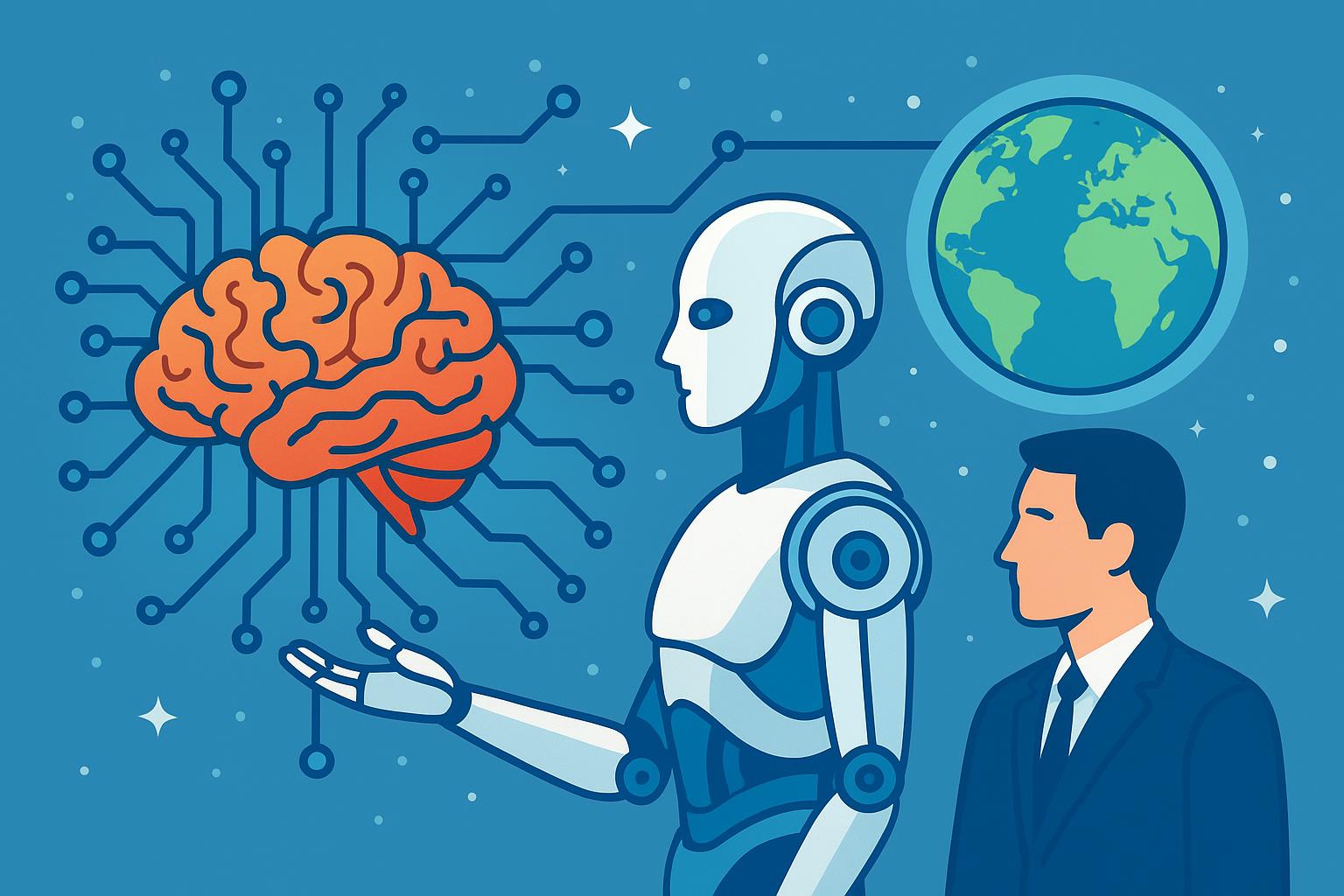
The Architecture of Autonomous Systems: Foundational Principles and Strategic Applications in Advanced Cognition
Google DeepMind • Google DeepMind robotics lab tour with Hannah Fry
Google DeepMind • From sketches to prototype: Designing with generative AI
Google DeepMind • Veo 3.1 - Designed to empower creatives
Google DeepMind • Veo 3.1 - Add and remove objects to your scene
Google DeepMind • Waymo: The future of autonomous driving | Vincent Vanhoucke
Google DeepMind • WeatherNext 2: Our most advanced weather forecasting model
Google DeepMind • Veo 3.1 - Create longer, seamless shots
Google DeepMind • Project Genie | How image upload works
Google DeepMind • Part 1: Social engineering, malware, and the future of cybersecurity in AI | Four Flynn
Google DeepMind • Part 2: Social engineering, malware, and the future of cybersecurity in AI | Four Flynn
Google DeepMind • Gemini 3: Reasoning with voxel art
Google DeepMind • Nano Banana Pro: Your new creative partner
Google DeepMind • Veo 3.1 - Ingredients to video
Google DeepMind • Veo 3.1 - Frames to video
Google DeepMind • The future of intelligence | Demis Hassabis (Co-founder and CEO of DeepMind)
Google DeepMind • Gemini 3 Flash: Orchestrate a function call kitchen
Google DeepMind • Project Genie | How world remixing works
Google DeepMind • Introducing SIMA 2, the next milestone in our research creating general and helpful AI agents.
Google DeepMind • Gemini 3 Flash: Generate a narrative of your journey
Google DeepMind • The Thinking Game | Documentary trailer
Google DeepMind • Gemini Robotics 1.5: Learning across embodiments
Google DeepMind • Veo 3.1 and more artistic control in Flow
Google DeepMind • Gemini 3: Turn a research paper into an interactive website
Google DeepMind • AlphaFold: Grand challenge to Nobel Prize | John Jumper
Google DeepMind • Gemini Robotics 1.5: Thinking while acting
Google DeepMind • Vibe Coding with Gemini 3 in Google AI Studio
Google DeepMind • Gemini 3 Flash: Evolve code faster
Google DeepMind • Gemini 3: Code a retro 3D spaceship game with a single prompt
Google DeepMind • Gemini Robotics 1.5: Enabling robots to plan, think and use tools to solve complex tasks
Google DeepMind • A new era of intelligence with Gemini 3
Google DeepMind • AlphaGenome author roundtable
Google DeepMind • The Thinking Game | Full documentary | Tribeca Film Festival official selection
Google DeepMind • Gemini 3: Code a 3D visualization of the universe
Google DeepMind • AlphaFold: The 50-year grand challenge cracked by AI
Google DeepMind • The arrival of AGI | Shane Legg (co-founder of DeepMind)
Google DeepMind • Project Genie | How world sketching works
Content Summary
This report is generated from research on the following videos, based on the requirements set in Video Deep Research.
Analyze selected videos,
My goal is 📑 Discover Content Intelligence
My role is 📚 Student/Learner/Researcher
I need: 📝 Key concept summarization and concept mapping, 🤔 Knowledge gap identification, 🛤️ Learning pathway recommendations, 📖 Academic source validation and credibility check, 📋 Study guide creation with practice questions and quiz generation


https:...mind
Summary
1. The Evolution from Retrieval to Autonomous Agency
2. Accelerating Scientific Discovery via Predictive Modeling
3. Embodied Intelligence and Physical World Logic
4. Safety Architectures and Ethical Alignment Frameworks
5. Collaborative Creativity and Structural Societal Adaptation
Knowledge Snap
Concept 1: Multimodal Foundation Models
🎬 Related Clip
(8)
Video Title
00:04 - 00:22
The Gemini models have been designed to handle multiple modes of data from their inception.
Video Title
01:00 - 03:04
The primary focus of intelligence research has moved from language models to interactive agent systems.
Video Title
15:06 - 17:20
Modern intelligence systems are capable of communicating in approximately one hundred and fifty different human languages.
Video Title
00:08 - 00:26
The model uses its deep understanding of reality to help users reflect and reimagine complex details.
Video Title
01:43 - 02:48
Technology is being transformed by the integration of large language and multimodal models.
Video Title
00:40 - 01:10
Developers enable the robotic system to think and process its surroundings before performing actions.
Video Title
00:00 - 00:19
The model reliably handles a massive volume of software function calls with very low delays.
Video Title
00:00 - 00:20
This application builds a narrative description based on the specific travel route provided by the user.
Concept 2: Agentic Autonomy and Reasoning
🎬 Related Clip
(8)
Video Title
00:20 - 00:35
This agent completes difficult tasks that require navigating multiple complex steps in a virtual world.
Video Title
20:00 - 22:06
Interactive models represent a significant step toward demonstrating that systems have a generalized understanding.
Video Title
25:11 - 27:12
Researchers are actively working to make artificial intelligence systems behave in a more agentic manner.
Video Title
00:23 - 00:38
A specialized version of the model powers three distinct agents to perform complex kitchen tasks.
Video Title
01:44 - 02:21
The model can break down broad instructions and perform them over several logical steps.
Video Title
01:49 - 02:19
Adding reasoning capabilities allows the robot to chain together a long series of complex tasks.
Video Title
00:08 - 00:23
The primary life goal for this researcher is to successfully develop artificial general intelligence.
Video Title
00:14 - 00:30
Advanced reasoning enables these agents to think through coding problems and take physical actions.
Concept 3: Embodied Physical Intelligence
🎬 Related Clip
(8)
Video Title
00:09 - 01:09
Researchers are embedding the reasoning capabilities of the model into a physical robotic body.
Video Title
00:00 - 00:30
Multimodal understanding allows robots to behave effectively while interacting with the physical human world.
Video Title
00:58 - 01:29
This specific model is designed to power sophisticated humanoid robots to perform complicated daily tasks.
Video Title
00:28 - 00:47
Researchers are now using a single intelligence model to control multiple different types of robots.
Video Title
00:28 - 02:28
These large autonomous vehicles use numerous sensors but operate without any human behind the wheel.
Video Title
18:26 - 20:26
There is a significant amount of information about spatial dynamics and physical context that is difficult to describe.
Video Title
01:20 - 01:40
A robotic arm works within an industrial setting to bring complex design concepts to life.
Video Title
29:26 - 31:26
The group developed an environment where a simulated robot could learn to navigate its surroundings.
Concept 4: Generative Media and Content Creation
🎬 Related Clip
(8)
Video Title
00:06 - 00:21
The system combines various ingredients into a complete video scene that includes high-quality sound.
Video Title
00:00 - 00:17
This video generation model is specifically designed to enhance the creative control of its users.
Video Title
00:00 - 00:07
Users can reimagine any shot by adding or removing elements ranging from details to objects.
Video Title
00:02 - 00:17
The model allows users to extend their clips and transform single shots into full scenes.
Video Title
00:00 - 00:15
The software creates high-quality transitions to bridge the start and end points of a shot.
Video Title
00:40 - 01:04
Google's new creative partner gives users control over storytelling elements like color and lighting.
Video Title
00:23 - 00:38
The narrator suggests that every city has a story if a person is willing to listen.
Video Title
00:37 - 00:52
The goal was to train the image generation model on a vast archive of sketches.
Concept 5: Data-Driven Scientific Discovery
🎬 Related Clip
(8)
Video Title
00:22 - 00:39
This leap forward is expected to accelerate drug discovery and help researchers understand diseases better.
Video Title
01:04 - 03:04
This system solves a grand biological challenge by predicting the three-dimensional structures of various proteins.
Video Title
00:19 - 01:19
The model predicts the functional impact of genetic variants by mapping DNA sequences to functions.
Video Title
46:29 - 48:29
Proteins are created from strings of amino acids that fold into complex and unique structures.
Video Title
02:38 - 04:44
The success of AlphaFold served as a major proof point for solving complex problems.
Video Title
00:20 - 00:58
The model understands the complex relationships between various variables that constitute global weather patterns.
Video Title
00:30 - 00:32
Gemini 3 million stable crystals.
Video Title
00:26 - 00:42
The ultimate objective of the research was to solve the most complex scientific challenges globally.
Concept 6: AGI Milestones and Metrics
🎬 Related Clip
(7)
Video Title
01:54 - 03:54
Minimal general intelligence is defined as an artificial agent that can perform typical human cognitive tasks.
Video Title
06:09 - 08:26
One would expect a general intelligence system to possess a broad and consistent level of capability.
Video Title
42:17 - 44:17
The system demonstrated superhuman elements by coming up with advanced hypotheses regarding software libraries.
49:23 - 51:24
Large language models are fundamentally different because they operate in a non-deterministic manner.
Video Title
12:47 - 14:47
This discovery would significantly accelerate the timeline for achieving artificial general intelligence for the team.
Video Title
00:08 - 00:23
Solving the challenge of general intelligence has been a lifelong goal for the founding researcher.
Video Title
00:26 - 00:41
This is currently the strongest model globally for multimodality and logical reasoning tasks.
Concept 7: Interactive World Prototyping
🎬 Related Clip
(8)
Video Title
00:00 - 00:22
Exploring various worlds can serve as inspiration for creating entirely new environments for users.
00:10 - 00:25
Gallery worlds can be used as a starting point for users to develop their own creations.
00:30 - 00:44
Creators can modify their characters and environments to produce an unlimited number of new worlds.
Video Title
00:00 - 00:15
Users can fine-tune their created worlds according to their specific personal vision and ideas.
00:39 - 00:55
Users can see a preview of their world by clicking the create sketch button.
01:01 - 01:16
Once the sketch is complete, users can explore their world by clicking the create world button.
Video Title
00:00 - 00:24
The system allows users to build interactive worlds based on images they have captured.
00:15 - 00:31
Users upload their photos alongside detailed descriptions of the environment and character responses.
Concept 8: Autonomous Navigation and Logic
🎬 Related Clip
(8)
Video Title
05:00 - 07:00
The combination of environment and rules makes the autonomous driving problem extremely difficult to solve.
15:30 - 17:47
Driving is described as an inherently social activity that involves visual conversations between road users.
16:34 - 18:39
Training artificial intelligence for driving requires a closed-loop system to evaluate learning effectively.
20:02 - 22:14
Categorizing different agents on the road is important for making decisions based on world rules.
41:40 - 43:40
People place a massive amount of trust in the system and engineers must work to meet it.
Video Title
19:34 - 21:36
Systems must understand intuitive physics, including how objects move and behave within their environment.
22:39 - 24:42
The system generates the surrounding world based on whatever the agent is currently trying to achieve.
24:10 - 26:11
Researchers are creating a physics benchmark to test if models have encapsulated basic physical laws.
Concept 9: System Safety and Ethical Alignment
🎬 Related Clip
(8)
Video Title
36:39 - 38:41
The researcher introduces the concept of system two safety for handling difficult ethical situations.
06:10 - 08:15
So, for example, if you want to do continual learning, so the AI keeps learning over time, you.
30:10 - 32:10
A growing collection of tests is used to identify and mitigate risky areas in intelligence.
Video Title
22:25 - 24:30
Defense in depth is a security concept used to protect systems through multiple layers of control.
36:07 - 38:07
A robust security strategy requires having multiple layers of defense built around the core model.
Video Title
06:47 - 07:48
Security professionals know that bad actors will eventually attempt to find and exploit existing vulnerabilities.
Video Title
43:21 - 45:26
Most major research labs are attempting to be responsible as they develop powerful new technologies.
Video Title
01:05:00 - 01:07:00
Researchers must be cautious about what features they build into the general intelligence systems.
Concept 10: Human-AI Collaborative Design
🎬 Related Clip
(8)
Video Title
00:07 - 00:22
With the advent of intelligence, designers stand at an entirely new frontier for creative exploration.
00:24 - 00:48
Researchers work with artists to explore how they might utilize intelligent tools in their work.
01:01 - 01:19
After a foundational concept is chosen, the intelligence model is used to further refine the design.
01:23 - 01:40
This project provides a glimpse into a future where intelligence empowers humans to think differently.
01:34 - 01:46
The process shows that intelligence can bring unique and extraordinary elements to the design process.
Video Title
42:39 - 44:46
In the near future, the fraction of software written by humans will likely decrease significantly.
Video Title
00:02 - 00:19
The new coding environment allows users to build anything they can imagine using intelligent tools.
00:16 - 00:31
Users can build entirely new applications with just a single descriptive prompt in the studio.
Concept 11: Real-Time Coding and Adaptation
🎬 Related Clip
(8)
Video Title
00:08 - 00:23
The studio enables developers to build entirely new experiences using advanced coding capabilities.
01:03 - 01:07
The technology allows creators to bring virtually any idea to life through simple interactions.
00:41 - 00:56
Developers can continuously refine their projects through an iterative process supported by the model.
Video Title
00:02 - 00:18
A new intelligence model enables an entirely different way for developers to build software.
00:05 - 00:24
Low latency capabilities allow for real-time testing of multiple code generations during development.
00:30 - 00:44
This type of learning based on user feedback is applicable to any personal assistant software.
Video Title
00:10 - 00:22
Pink and yellow neon light in dark room with grid pattern.
Video Title
00:00 - 00:15
There was no transcript available because the video may only contain background music or no sound or an.
Concept 12: Societal Transformation Dynamics
🎬 Related Clip
(8)
Video Title
00:30 - 02:30
Society must think deeply about how to structure a new world in response to intelligence.
38:01 - 40:02
The researcher notes that the overall economic pie should become much larger for society.
43:47 - 45:47
Intelligence will lead to structural changes in the economy, society, and various other sectors.
40:45 - 42:46
Society is currently standing on the edge of an exponential curve of intelligence development.
Video Title
37:48 - 39:51
It is fascinating to see how the whole of society had to adapt over time.
39:06 - 41:09
The speaker believes economists and governments should spend more time thinking about social reconfiguration.
39:55 - 41:59
The researcher suggests there might be better and more direct systems for distributing resources.
Video Title
02:56 - 04:56
This is described as a hugely critical moment for the future of all humanity.
The Trajectory of Artificial General Intelligence
The arrival of AGI | Shane Legg (co-founder of DeepMind)
UCP7jMXSY2xbc3KCAE0MHQ-A
🧠
Defining Basic Intelligence
01:54 - 03:54
Establishing a baseline for minimal general intelligence in machines.
📊
Current Performance Gaps
35:41 - 37:41
Identifying the uneven capabilities across modern cognitive systems.
👁️
Visual Reasoning Challenges
03:27 - 05:28
Understanding why machines struggle with complex spatial and visual scenarios.
🚀
Surpassing Human Limits
07:26 - 09:34
Exploring the potential for systems to exceed human-level cognition.
🛡️
Frameworks for System Safety
05:58 - 08:02
Implementing specialized reasoning protocols to ensure safe operational behavior.
🤖
The Rise of Autonomous Agents
25:40 - 27:40
Predicting the shift toward independent software and robotic agents.
🔍
Continuous Monitoring Protocols
28:05 - 30:05
The necessity of active oversight for high-capability models.
🌎
Anticipated Societal Shifts
18:21 - 20:21
Preparing for structural economic and social changes driven by intelligence.
Learning Pathway for Content Intelligence Foundations
| Stage | Videos |
|---|---|
1. Foundational Research Objectives | The Thinking Game | Full documentary | Tribeca Film Festival official selection |
2. Scaling versus Innovation Strategies | The future of intelligence | Demis Hassabis (Co-founder and CEO of DeepMind) |
3. Multi-Step Task Decomposition | Gemini Robotics 1.5: Enabling robots to plan, think and use tools to solve complex tasks |
4. Semantic Interpretation of Visual Content | Waymo: The future of autonomous driving | Vincent Vanhoucke |
5. Biological and Scientific Predictive Modeling | AlphaFold: The 50-year grand challenge cracked by AI |
6. Infrastructure Security and Defense | Part 1: Social engineering, malware, and the future of cybersecurity in AI | Four Flynn |
7. Agentic Internet and Information Retrieval | Gemini Robotics 1.5: Enabling robots to plan, think and use tools to solve complex tasks |
8. Visionary Productivity and Future Use Cases | The future of intelligence | Demis Hassabis (Co-founder and CEO of DeepMind) |
Detailed Findings and Insights
1. Historical Clues in DNA
🎬 Related Clip
(4)
Video Title
00:56 - 01:58
DNA functions as the historical source code that evolution has developed over millions of years.
Video Title
01:20 - 01:35
Researchers can now predict protein functions based on their structures, which was previously impossible.
Video Title
15:43 - 17:52
Scientists must first achieve biological understanding to bring meaning to various components in a cell.
Video Title
00:33 - 00:48
Proteins are described as the machines of life that drive all biological processes.
2. Benchmarks for Physical Accuracy
🎬 Related Clip
(4)
Video Title
24:10 - 26:11
Researchers are creating a physics benchmark to test if models have encapsulated basic physical laws.
Video Title
13:46 - 15:47
Simulation serves as a critical way to validate that technology is advancing safely and effectively.
Video Title
00:58 - 01:29
The model was not explicitly trained to perform certain emergent physical tasks during the demo.
Video Title
00:55 - 01:10
The model generates cinematic outputs that include astonishing detail and realistic world physics.
3. The Dagger Paradox in Training
🎬 Related Clip
(4)
Video Title
17:11 - 19:11
Training models in a closed loop enables the learning of behaviors required for complex driving.
Video Title
06:49 - 07:49
Researchers emphasize that the model must learn how to perform tasks directly from the data.
Video Title
00:00 - 02:00
So is human intelligence going to be the upper limit of what's possible?
Video Title
22:47 - 24:47
This could mark the beginning of a training loop where systems have infinite training examples.
4. Contextual Integrity in Security
🎬 Related Clip
(4)
Video Title
24:05 - 25:05
Researchers are teaching the model to handle the challenges of maintaining contextual integrity during interactions.
20:34 - 21:36
The system calculates risk based on a huge array of different unconscious behavioral signals.
14:29 - 15:30
New technology allows for the cloning of individuals for use in live video experiences.
Video Title
29:32 - 31:35
Language models are currently susceptible to similar types of confusion that humans experience.
5. Industrial Revolution Parallels
🎬 Related Clip
(4)
Video Title
39:06 - 41:09
The speaker believes economists and governments should spend more time thinking about social reconfiguration.
38:34 - 40:39
The current technological transformation is expected to unfold over a decade rather than a century.
Video Title
40:08 - 42:10
The researcher compares the current situation to the complexities of the historical Industrial Revolution.
Video Title
36:34 - 38:34
A historical comparison is made between unleashing a new force and past scientific breakthroughs.
6. Design Iteration Limits
🎬 Related Clip
(4)
Video Title
01:29 - 01:46
For the designer, the final result of the project transcends the traditional debates on design.
00:48 - 01:06
The team generated hundreds of different iterations and permutations for a single chair design.
Video Title
00:36 - 00:51
The intelligent interface allows users to refine and then further refine their digital creations.
Video Title
00:30 - 00:45
Creators can visualize a brand and then see how it would appear in various locations.
7. Localized Outcome Measurement
🎬 Related Clip
(4)
Video Title
40:07 - 42:09
The speaker suggests that certain societal decisions actually happen at a local community level.
40:21 - 42:22
The speaker notes that it might be possible to accurately measure the outcomes of community decisions.
38:38 - 40:39
Society must reconfigure its structure in a way that works for everyone in the future.
Video Title
38:16 - 40:18
The researcher questions how the existing wealth in society should be distributed fairly.
8. Stochasticity in Hallucinations
🎬 Related Clip
(4)
Video Title
23:32 - 25:32
The researcher discusses the introduction of stochasticity and the potential for systems to hallucinate.
24:02 - 26:02
Wrong answers in newer versions of the model can sometimes appear more plausible than before.
Video Title
16:25 - 18:26
The model sometimes forces itself to provide an answer even when it is uncertain.
23:40 - 25:41
The speaker addresses the issue of basic hallucinations appearing in creative exploration tasks.
9. Adversarial Probing of Intelligence
🎬 Related Clip
(4)
Video Title
16:17 - 18:20
Researchers suggest conducting an adversarial test after a system passes a standard battery of tests.
16:25 - 18:37
The job of testing teams is to find cognitive tasks where the intelligence system fails.
17:03 - 19:08
General intelligence systems will become so capable that their generality will seem obvious to people.
Video Title
15:38 - 17:39
Metrics indicated that the system can still give an answer when it should actually decline.
10. Multi-Protein Complexes
🎬 Related Clip
(4)
Video Title
16:45 - 18:49
Researchers are already considering the problem of how multiple proteins interact in complexes.
16:23 - 18:23
All of these various biomolecules are constantly interacting with each other in the body.
Video Title
46:29 - 48:29
Proteins are created from strings of amino acids that fold into complex and unique structures.
Video Title
10:26 - 11:28
Expressing a functional protein requires bringing all contiguous biological information together effectively.
11. Abstract vs Concrete Tokens
🎬 Related Clip
(4)
Video Title
30:23 - 32:23
Concrete information allows for the simulation of states in a much more direct and powerful way.
30:09 - 32:09
Developers must decide if they want abstract tokens or information that is more concrete.
13:09 - 15:15
The vehicle looks at geometric information obtained from its various sensors to form a belief.
Video Title
19:34 - 21:36
Systems must understand intuitive physics, including how objects move and behave within their environment.
12. Data Loading Resolution Trade-offs
🎬 Related Clip
(4)
Video Title
04:41 - 05:41
In order to extend the sequence length, researchers had to sacrifice some of the prediction resolution.
08:23 - 09:28
The model is capable of processing very long genetic sequences while maintaining high resolution.
05:39 - 06:39
The input sequence length is extremely long and results in very finely detailed predictions.
04:41 - 05:41
Researchers extended the sequence length significantly to capture more information during the process.
